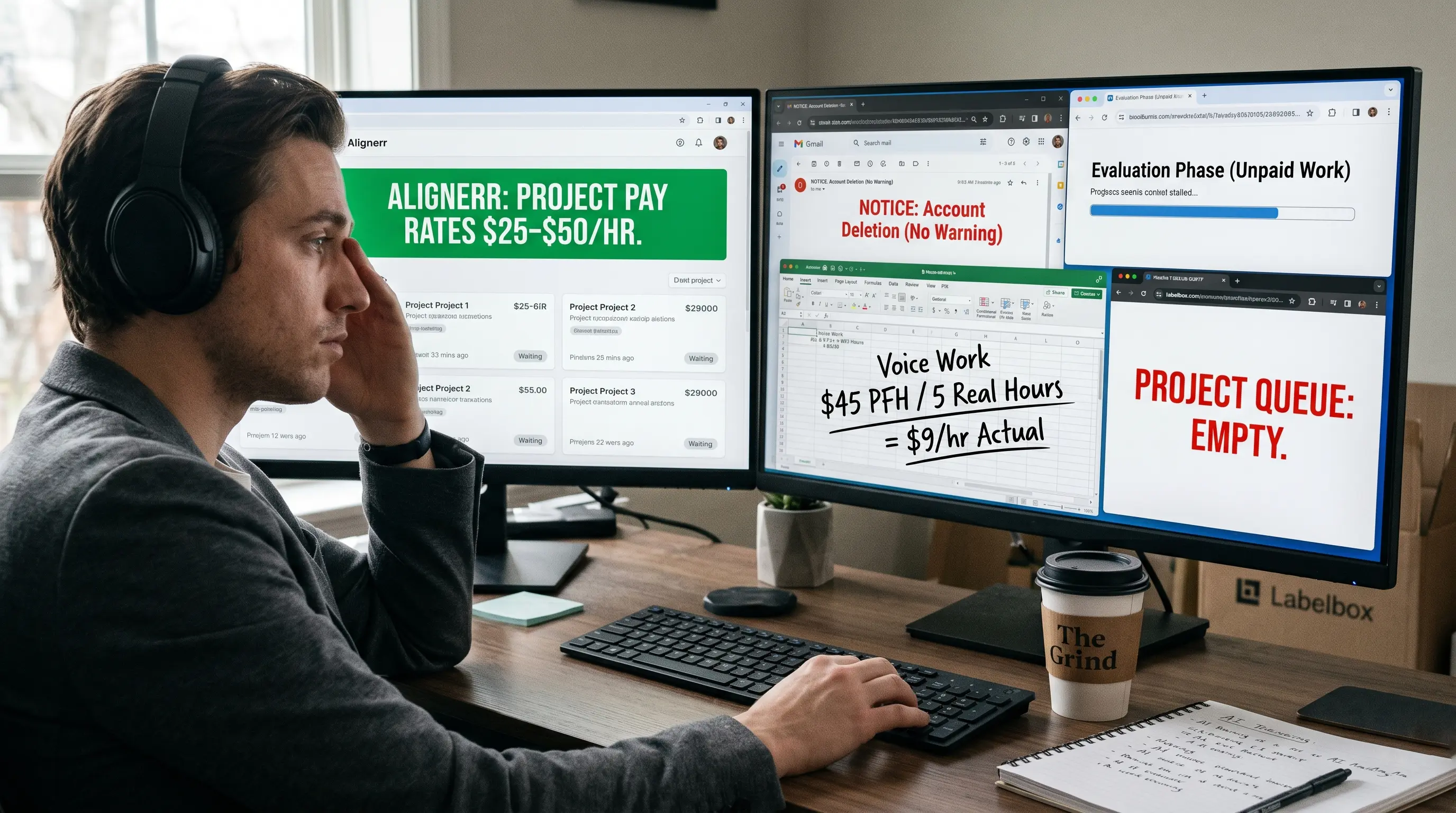
Alignerr Review 2026: Pay, Projects, and the Labelbox Problem
TL;DR: Alignerr is real. It is operated by Labelbox, pays via PayPal on Wednesday/Thursday/Friday, and advertises $25–$50/hr. Community-reported rates widen that to $15–$60/hr (avg $37). The catch: evaluation phases are often unpaid, account deletions happen with no warning, qualified workers go months between projects, and voice work billed Per Finished Hour collapses to about $9 per real hour worked. Apply if you have the credentials. Don't budget around it.
I've had the Alignerr dashboard open since early 2025. Not every day — you can't, because there isn't work every day. That's the central contradiction of this platform in a sentence. It advertises high rates, attracts credentialed people, and then leaves them staring at a nearly empty project board for weeks at a stretch.
That said, it's real. The pay processes. The tasks are interesting. It's just not what the recruiter ads imply.
Here is what is actually going on inside Alignerr in 2026, based on my own time on the platform and the sentiment data I pull from the community.
What Alignerr Is — and Why the Setup Matters
Alignerr is an AI training platform operated by Labelbox, the enterprise data labeling company that sits underneath a lot of the AI training work you've heard about. Labelbox is the infrastructure layer; Alignerr is its freelance workforce arm.
The setup is unusual compared to Outlier or DataAnnotation. You don't just sign up and get a general queue. You apply to specific projects through a job board on the Alignerr site. Think contractor listing board — you browse open positions, submit an application, and if you're selected, you work inside Labelbox (a separate tool) on that specific project.
When a project ends, it ends. You go back to the job board and apply again.
This project-by-project structure is both the strength and the trap. The strength: focused work, clear scope. The trap: if no projects match your expertise, you can wait months between active gigs.
The Pay: What Alignerr Pays in 2026
Alignerr advertises $25–$50/hr. My sentiment tracker pulls 81 community data points for Alignerr in the latest snapshot, and the community-reported range widens to $15–$60/hr with an average around $37/hr — once you include the low-rate evaluation phases at the bottom and credentialed specialist work at the top.
| Task Type | Pay Range | Notes |
|---|---|---|
| General AI preference feedback | $15–$25/hr | Entry tier; some early-evaluation work falls here |
| Domain projects (STEM, technical) | $25–$45/hr | Requires verified credentials |
| Coding (advanced) | $40–$60/hr | Senior-level, specific stack |
| Voice/audio work (Per Finished Hour) | $35–$45/hr listed | About $9/hr in real labor — see below |
| Translation & transcription | $20–$30/hr | Language-specific, lower ceiling |
The voice work number requires a footnote the size of a warning label. Alignerr — like most of the voice industry — bills voice projects Per Finished Hour of audio produced, not per hour you work. A finished minute of clean audio takes four to seven actual hours of recording, editing, and re-recording to deliver. A $45/hr Per Finished Hour task that takes five hours of real labor pays roughly $9 per actual hour worked. I went deep on the math in my Outlier vs. Alignerr breakdown.
For cognitive work — coding evaluations, preference feedback, human quality review — the rates are real. $30–$50/hr is achievable for qualified workers who land the right projects. The hard part is landing them.
Payment processes weekly via PayPal — typically landing Wednesday, Thursday, or Friday. No Hyperwallet — that's Outlier's processor, not Alignerr's. Stripe shows up in their documentation but I've never seen anyone actually paid through it. For the full breakdown of how the pay cycle works, see the Alignerr payment schedule.
Application, Evaluation, and the Wait That Follows
Here is where Alignerr gets complicated and where a lot of qualified people lose time.
Step 1: Verify your identity. Alignerr requires a government ID and biometric checks through their verification partner before you can apply to anything. This step alone blocks many international applicants — Alignerr is effectively US-only despite calling itself remote. Workers in Bangladesh, China, and several other markets have reported being blocked even after passing every other screen.
Step 2: Apply to projects through the job board. Once verified, you browse open projects and apply. Some require STEM degrees. Some want specific coding languages. Some just want English fluency and good judgment. You submit, you wait.
Step 3: Complete an evaluation inside Labelbox. If selected, you create a Labelbox account and get assigned to an evaluation phase. This is where it gets ugly. The evaluation is real work — hours of preference ranking, output scoring, or task completion, the same kind of work you'll do if you pass. The pay for this phase is often low or unpaid entirely. Workers have reported spending three to five hours on evaluations and receiving nothing when they don't advance.
One worker put it cleanly: "I spent hours on a Human Preference Feedback task. Real work. Then everything disappeared — the task, the Discord, any communication. No explanation, no closure."
That is not an edge case. That is a pattern.
Step 4: Get hired. Then wait. If you pass, you're officially on the project. Except: Labelbox has no notification system for task assignments. You can get hired, complete onboarding, and miss the first wave of tasks because nobody tells you tasks are available. You have to check Labelbox manually, regularly. Workers have reported logging in weeks after being hired only to find a task they were assigned was already marked as missed.
Once a project does land, the cycle restarts. A project launches, workers flood in during the initial sprint, volume drops off, the project winds down, and you're back to the job board. Some workers report being active on a project for six weeks, then going idle for three months before the next project they qualify for opens. I've written at length about the empty queue phenomenon in AI gig work, and Alignerr has it as bad as anyone — worse, in some ways, because the project-based model makes the ebbs longer and harder to predict than Outlier's general queue. At least on Outlier, you know tasks might appear tomorrow.
Account Deletion and the Reviewer Problem
This part matters. Alignerr removes accounts without warning, and the accounts targeted aren't always the workers you'd expect.
Recent reports include a worker removed from an ATC project with a 4.6 rating — the notification came with no explanation. Another had their account fully deleted after months of active work and advancement into higher tiers, with zero prior quality flags. They still receive Labelbox contracts on Upwork from the same underlying projects.
The reviewer inconsistency is its own structural issue. Within the same projects, multiple workers have reported tasks that passed one week being re-reviewed and failed the next, with no change in the underlying work quality. When 100 workers report the same anomaly and management doesn't address it, you're not dealing with a performance problem. You're dealing with a structural one.
If your account gets removed, it's permanent. There is no appeal path that workers have found to be effective. This is closer to the Outlier account removal experience than most people expect from a platform with Alignerr's reputation.
Is Alignerr Legit — and Where Does It Sit Now?
Yes, in the sense that matters: it pays. The company is real (Labelbox is an established player in enterprise AI), the tasks produce real AI training data, and verified workers receive payment via PayPal weekly.
The current sentiment number is the part that has moved. My tracker puts Alignerr at 38/100, Warning, trend down — based on 81 posts analyzed, data as of May 9, 2026. Outlier sits at sentiment 39, also Warning, also trending down. Both platforms are now operating in the same Warning territory by the numbers. The comparison still holds; the framing is no longer "Tier B alongside Outlier" but "two platforms both throwing the same warning signal at the same time." On the tier list I maintain at /blog/ai-training-jobs-2026-platform-tier-list, Alignerr's project-availability problem and account-removal pattern push it lower than Outlier despite their close sentiment scores. Worth your time, not your trust.
Apply to Alignerr if:
- You have strong credentials — CS degree, domain expertise, professional writing or coding background.
- You can absorb a four-to-eight-week ramp from application to first paycheck.
- You're already working on Outlier or DataAnnotation and want Alignerr as an additional faucet, not the main one.
- You're in the US or another supported country.
Skip Alignerr if:
- You need reliable weekly income now — the project gaps are too unpredictable.
- You're outside the supported geography.
- You're hoping to do voice work at the advertised $40+/hr — the real rate after time accounting is closer to $9/hr.
- You can't tolerate doing hours of real evaluation work with no guaranteed pay.
Frequently Asked Questions
Does Alignerr pay weekly? Yes. Payments process weekly via PayPal, typically landing Wednesday through Friday. Stripe appears in Alignerr's documentation but is not used in practice.
Do I need a degree to work for Alignerr? Not for every project — some general preference feedback roles accept strong writing samples and English fluency. STEM and coding projects require verified credentials.
Is the evaluation paid? Often no, or very low. This is the most important thing to go in knowing. Evaluation phases are structured to look like training but frequently constitute real, scored work with no guaranteed compensation.
Can I work from outside the US? In theory, yes. In practice, Alignerr has significant geographic restrictions. Workers in China, Bangladesh, and several other countries report being blocked during identity verification.
What happens if my account gets deleted? It's permanent. There is no known appeals process that has worked for workers removed from the platform.
How long does it take to get hired? Four to eight weeks from application to first active task is realistic. Apply to multiple projects simultaneously.
What is the WorldSim evaluation on Alignerr? WorldSim is a long-term, full-time software-engineering evaluation project — workers evaluate Claude Code output, comparing AI-generated coding responses, analyzing diffs, checking correctness, and writing evidence-backed justifications. It reportedly pays $90/hr, the highest publicly advertised rate on the platform. You get two attempts at the eval; passing reportedly earns you $100 for the eval itself plus access to production work, while failing both attempts means no eval compensation. This is the exception to Alignerr's usual unpaid-eval pattern, and it's a real project worth taking seriously — we break it down in full in Alignerr's WorldSim Eval: $90/hr long-term AI work. If you're invited, complete it carefully and document your time.
Apply if you have the credentials. Build a budget around it only if you also have three other faucets running.
Looking for a head-to-head? I put Alignerr against Outlier in Outlier AI vs. Alignerr: Which Pays Better?. For the broader picture of which platforms are worth your time, read The 2026 AI Training Jobs Tier List. If you're weighing the highest-floor platform in the space instead, my Handshake AI review covers the $80/hr tier and the offboarding pattern that comes with it. And if you've been staring at an empty project board for weeks, you're not alone — here's what that pattern looks like across every platform.
Sentiment scores and platform rates as of May 9, 2026, from the breakingeven.online tracker (81 Alignerr posts analyzed, data window 2026-04-04 to 2026-04-15).
Everything we track on Alignerr: pay, reviews, and how to apply
Read Next
From the community
Join the conversation — no email needed →What workers are talking about
Comments
Leave a comment
Joshua Drake has worked on AI training platforms for over four years, tracking earnings, sentiment data, and platform stability across Outlier, DataAnnotation, Alignerr, and others. He has a degree in data analytics and runs this site, breakingeven.online and the sentiment analysis used to derive a sense of what is happening in a world often hiding in the shadows.