
Outlier AI Empty Queue: Fired, Glitched, or Just Paused? How To Tell
TL;DR: An empty queue on Outlier AI or DataAnnotation usually means the project batch ended, not that you did something wrong. It can also mean a quality flag, a platform outage, or a silent account removal. There is no HR to call — support sends canned responses. If your queue has been empty for 2+ weeks with no communication, treat it as permanent and apply to other platforms immediately. The "Empty Queue" is a feature of gig work, not a glitch.
In the traditional working world, getting fired is a loud event. There is a meeting. There is a letter. There is an uncomfortable conversation with an HR representative who hands you a cardboard box and explains your COBRA benefits. It is painful, but it is definite.
In the world of AI gig work, the end rarely comes with a bang. It comes with a loading spinner.
It happens on a Tuesday morning. You log in, coffee in hand, ready to work. But instead of a task, you see the dreaded white screen: "No tasks are currently available. Please check back later."
You wait. You refresh. You wait some more.
This is the Silent Severance. Sometimes it's temporary — a project ended. Sometimes it's permanent — your account was quietly removed. Here's how to tell the difference. It is the defining feature of "Black Box" management—a system where you are hired by an algorithm, managed by an algorithm, and eventually, fired by an algorithm. There is no HR department to call. There is no lifeguard on duty to save you. In these open waters, you are 100% on your own.
The business model is not designed to help you succeed. As we discussed in When The Robots Stop Paying, it is designed to replace you. Why would a company spend money to coach you on your mistakes when thousands of people are waiting in the lobby, ready to do the work for free during their qualification phase?
If you stay in this game long enough, you will face the EQ (Empty Queue). And when you do, you will inevitably go through the 6 Stages of Algorithmic Grief.
1. The "Glitch" Rationalization: Is the Platform Down?
"It's just a bug. The site is probably down."
This is the immediate reflex. Your brain refuses to accept that the income stream has been cut. You assume it's a technical error. You are a good worker; why would they fire you?
You start the ritual of the desperate. You refresh the page five times in a row. You clear your cache and cookies. You try Chrome, then Firefox, then Edge. You try logging in from your phone. You convince yourself that the server is just overloaded or that the project manager forgot to upload the weekend batch. You tell yourself, "It'll be back in an hour."
2. The Community "Pulse Check" (Panic)
"Is it just me?"
When the hour passes and the screen hasn't changed, the cold spike of adrenaline hits. You rush to the "water cooler"—the Discord servers, the subreddits, the Telegram groups.
You scan the chat logs with frantic energy. You type the universal distress signal of the gig worker: "Anyone else EQ on the Coding project?"
You are praying for a "Yes." You are looking for safety in numbers. If everyone is down, it's a system outage. If everyone else is working and you are the only one staring at a white screen, the reality begins to sink in.
3. The Evidence Gathering: Checking Metrics and Quality Scores
Whether you are a specific tasker for Outlier AI, Remotasks, DataAnnotation Tech, Appen, Mercor or Telus, the sudden appearance of 'No Tasks Available' is a universal panic inducer.
This is the bargaining phase, where you try to negotiate with a faceless system. You dig through your history (if you can still access it) to screenshot your high metrics. You read back through your feedback logs.
"But I have a 98% accuracy rating! There must be a mistake."
Common Reasons for EQ
- Review Pending: Your tasks are being graded by a reviewer.
- Project Ended: The specific project (e.g., "Ostrich", "Flamingo") has finished.
- Quality Flag: Your accuracy dropped below the threshold (often 90% or 95%).
- Platform Outage: The actual server is down.
You write a support ticket. You try to sound professional, but the desperation seeps through. "Hi Support, I think there is an error. I haven't received any negative feedback and my quality scores are high. Can you check my account?"
You hit send, hoping a human being—a real, empathetic human—will read it and say, "Oh no, we pressed the wrong button! Come back!"
4. The "Ghosted" Rage (Anger)
"I trained your model for six months, and this is the thanks I get?"
The reply comes (if it comes at all). It is a canned response, copied and pasted by a support agent who likely doesn't have the power to reactivate you anyway.
"Priorities are always changing based on the needs of the client. We will reach out if more tasks become available."
The rage is specific and burning. It's not just about the money; it's about the indignity. You realize you weren't an employee; you were a battery. You poured your mental energy into making their AI smarter, safer, and more profitable. And now that they have what they need, they have discarded you without so much as a "goodbye."
5. The "Guidelines" Paranoia (Depression)
"It was that one prompt, wasn't it?"
With no closure, the mind turns inward. You start to gaslight yourself. You replay the tasks you did three weeks ago.
"Did I miss a comma in that SQL query?"
"Did I rate that hallucination as 'Minor' when it should have been 'Major'?"
You obsess over the ambiguous rules of the project. You convince yourself that you aren't as smart or capable as you thought. The silence of the platform feels like a judgment on your worth as a human being.
6. The "Mercenary" Pivot: Finding New AI Training Platforms
"Fine. Who's hiring next?"
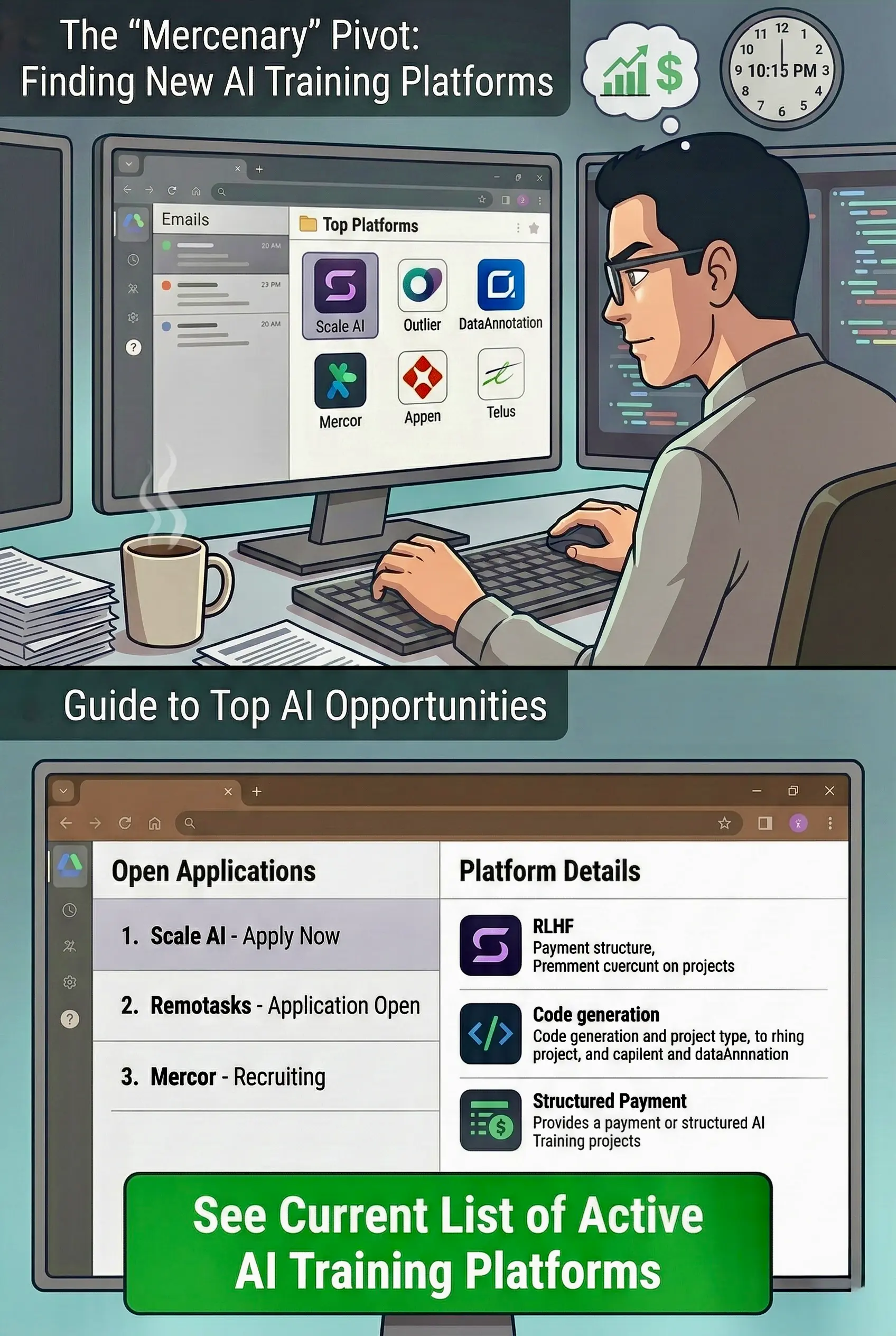
Eventually, the pity party ends. You realize the truth: These platforms are not employers. They are data faucets. Sometimes the water flows, and sometimes the pipes burst.
You stop checking the empty queue. You close the tab. You open your bookmark folder to the "Trading Cards" of the other platforms. You log into the competitor. You realize that loyalty in the age of AI is a liability.
You become a Mercenary. You work for the highest bidder, you save your money, and you never, ever trust the machine to love you back. You survived the ghosting, and you are smarter for it.
Also, if you're wondering how this whole boom and bust cycle actually works, I wrote about the economics of it: When The Robots Stop Paying.
The "Empty Queue" is not a glitch; it is a feature of the gig economy. It is the system working exactly as intended. Do not let it define your worth. When the screen goes white, don't mourn the job. Just find the next faucet.
The Mercenary Pivot
The only way to win is to not play by their rules. You need to always be looking for the next opportunity.
Don't just sit there. Start Applying:
See Current List of Active AI Training Platforms
Frequently Asked Questions
Why is my Outlier AI queue empty?
An empty queue on Outlier AI usually means one of four things: the project batch you were working on has ended, a new mandatory training module has been assigned and is blocking your access to tasks, your quality score has dropped below the platform's threshold, or Outlier is experiencing a wider platform outage. The most common cause is a project ending — it is rarely a personal quality issue. Check for any new enablement tasks in your dashboard before assuming the worst.
How long does an Outlier AI empty queue last?
It varies widely. A temporary outage or batch gap typically resolves within 24–72 hours. A project-end EQ can last days to several weeks while the platform onboards the next wave of work. A quality-related EQ may be indefinite — Outlier does not notify workers when they are removed from a project. If your queue has been empty for more than two weeks with no communication, treat it as permanent and move on to other platforms.
Does Outlier AI empty queue mean I'm banned?
Not necessarily. Empty queue and a ban are different things. A ban means your account has been suspended — you may still be able to log in but will see no available work and may receive a notification. An empty queue often just means the project ended or tasks haven't been assigned yet. If your quality feedback was consistently poor before the EQ appeared, a ban is more likely. If your feedback was fine, it is probably a project gap.
DataAnnotation "no tasks available" — what does it mean?
The "no projects available to work on" message on DataAnnotation is the same as Outlier's empty queue. It means either: there are no tasks matching your current qualifications, the project you were on has paused, or your quality score has been flagged. DataAnnotation provides even less communication than Outlier, so there is usually no way to know which of these applies. Log in daily and check back — many workers report tasks returning after a gap of several days to two weeks.
How do I know if I've been banned from DataAnnotation?
DataAnnotation does not send a ban notification. The practical signs are: your dashboard shows "no tasks" for an extended period (more than 2–3 weeks), your support tickets go unanswered or receive only automated replies, and no new projects appear even during periods when other workers report active queues. There is no appeals process. The only reliable way to know is the passage of time.
Can I get my Outlier AI or DataAnnotation account back after a ban?
Generally, no. Both platforms do not have a formal reinstatement process for workers. Some workers have reported successfully creating new accounts with different email addresses and devices, though this violates both platforms' terms of service. The more practical move is to diversify across multiple platforms so that a ban on one does not stop your income entirely.
While you're waiting for the queue to refill, it's a good time to diversify. See which platforms are active right now and check the AI Training Jobs 2026 Tier List for your next application. If you're evaluating your options, here's what each platform actually pays by task type — so you're not guessing. And if an Outlier queue drought has stretched into weeks with no updates, read what account removal actually looks like before assuming the worst.
Everything we track on Outlier: pay, reviews, and how to apply
Read Next
From the community
Join the conversation — no email needed →What workers are talking about
Comments
Leave a comment
Joshua Drake has worked on AI training platforms for over four years, tracking earnings, sentiment data, and platform stability across Outlier, DataAnnotation, Alignerr, and others. He has a degree in data analytics and runs this site, breakingeven.online and the sentiment analysis used to derive a sense of what is happening in a world often hiding in the shadows.