The Aether Project Is Winding Down. Here's What's Actually Happening.
TL;DR: The Aether project on Outlier AI is not dead — but the broad generalist version is over. Thousands of contributors were cut in early 2026 as the project shifted to specialized, higher-complexity tasks. What remains is narrower, more demanding, and hits budget limits fast. If you were removed, apply to DataAnnotation (closest equivalent for reasoning work), Telus AI (stability), or Alignerr (expert tracks). Do not wait for Aether to return to what it was.
You opened your dashboard. Queue is empty. You asked around — in the subreddits, in the Discord servers, in the group chats — and everyone has the same news: Aether is ending.
Except that's not quite what's happening.
I've been watching this play out across the community, and the reality is more complicated than a project just shutting down. The Aether project isn't dead. It's changing. And if you don't understand the difference, you're going to make the wrong moves when you can still make the right ones.
Let me break down what we actually know.
What Aether Was
For anyone who wasn't on it, Aether was the crown jewel of Outlier AI's project catalog for most of 2025. The tasks were high-complexity — multi-step reasoning, comparison work, multi-modal evaluation — and the pay reflected that. Aether sat at the top end of what Outlier actually pays per hour, and experienced workers could clear consistent hours on it. For a lot of people in this space, Aether was their income from Outlier.
The project was distributed across multiple platforms. That's standard practice in this industry: when a client has a large data contract and tight deadlines, they don't rely on one vendor. They spread the work — same tasks, different pipelines — to hit volume targets faster. Which is why workers started noticing that the "Multi-Mango" tasks appearing on other platforms bore a remarkable resemblance to what they'd been doing on Outlier. Because they were.
The full story of how Scale AI's $14.3 billion Meta deal caused this contraction is covered here. But the short version: the clients left, and the work left with them.
Nobody officially confirmed who the client is behind all of this. But in Reddit threads, Discord servers, and community posts from the past several months, workers have widely speculated it's connected to one of the major players — Meta or Google — based on the structure of the tasks and the timing of the contract cycles. That's community speculation, not confirmed fact. But it's worth knowing what the community is saying, because these patterns tend to be right.
What's Actually Happening Now
Here's the thing about "Aether is ending": it's true if you were a generalist on the project. It's not true if you're in the specialized track.
The purge already happened. Around the start of 2026, both Outlier and platforms running similar work performed significant cuts. Thousands of contributors were removed — not because of poor quality, but because the project shifted away from broad generalist tasks toward more specialized, higher-complexity work. If your queue went empty overnight without explanation, you likely got caught in that cut. If your account is fully gone — not just quiet — here's exactly what to do if your Outlier account was removed.
What remains is narrower and more demanding. The tasks that are still running are multi-modal evaluations, video-based content analysis, and higher-order reasoning work. If your profile includes tags for those tracks and your quality scores are in good standing, work still exists. It just looks different than it did in 2025, and it hits budget limits faster.
Budget gaps are real. Even workers who are still active are reporting empty queues — not because they've been removed, but because daily and weekly budget limits fill up quickly when fewer workers are doing more complex tasks. The "Empty Queue" you're seeing in the morning might have been a full queue four hours earlier.
So when someone tells you Aether is ending: what they mean is that the version of Aether that was accessible to most people is over. The version that continues is smaller, pickier, and harder to stay on.
The Handshake Question
The community has been vocal about this for weeks, and it's not a secret: workers who have access to Multi-Mango tasks on Handshake AI are doing the same core work as Outlier's Aether project. Same structure, same cognitive demands, different platform.
Where the Work Is Going
If you're off Aether and looking for where the same tier of work lives right now, here's what the community is tracking:
DataAnnotation is the closest equivalent for the text and reasoning work. Their chatbot comparison and evaluation tasks map directly onto what Aether was doing. The catch is the one-shot qualification — if you don't pass the assessment, you don't usually get a second attempt. But if you're in, the work volume and pay consistency are the best available right now.
Telus AI has been picking up multimodal and agentic AI evaluation contracts, which is where a lot of the Aether-style reasoning work is migrating. Their onboarding is slower — two to three weeks is typical — but the platform is more stable. You're less likely to wake up removed with no explanation.
Alignerr is the right destination if you were on the expert or technical tracks of Aether. The work is RLHF-focused and the pay for specialized tracks is high, but it's bursty — a lot of hours for two weeks, then nothing for a month. Plan for that.
OneForma is picking up the image and video evaluation work specifically. Workers have flagged projects like "Milky Way" as doing the same type of visual comparison that was at the core of the Multi-Mango tasks. If you speak a second language, the multilingual tracks pay meaningfully better.
The Pattern You Need to See
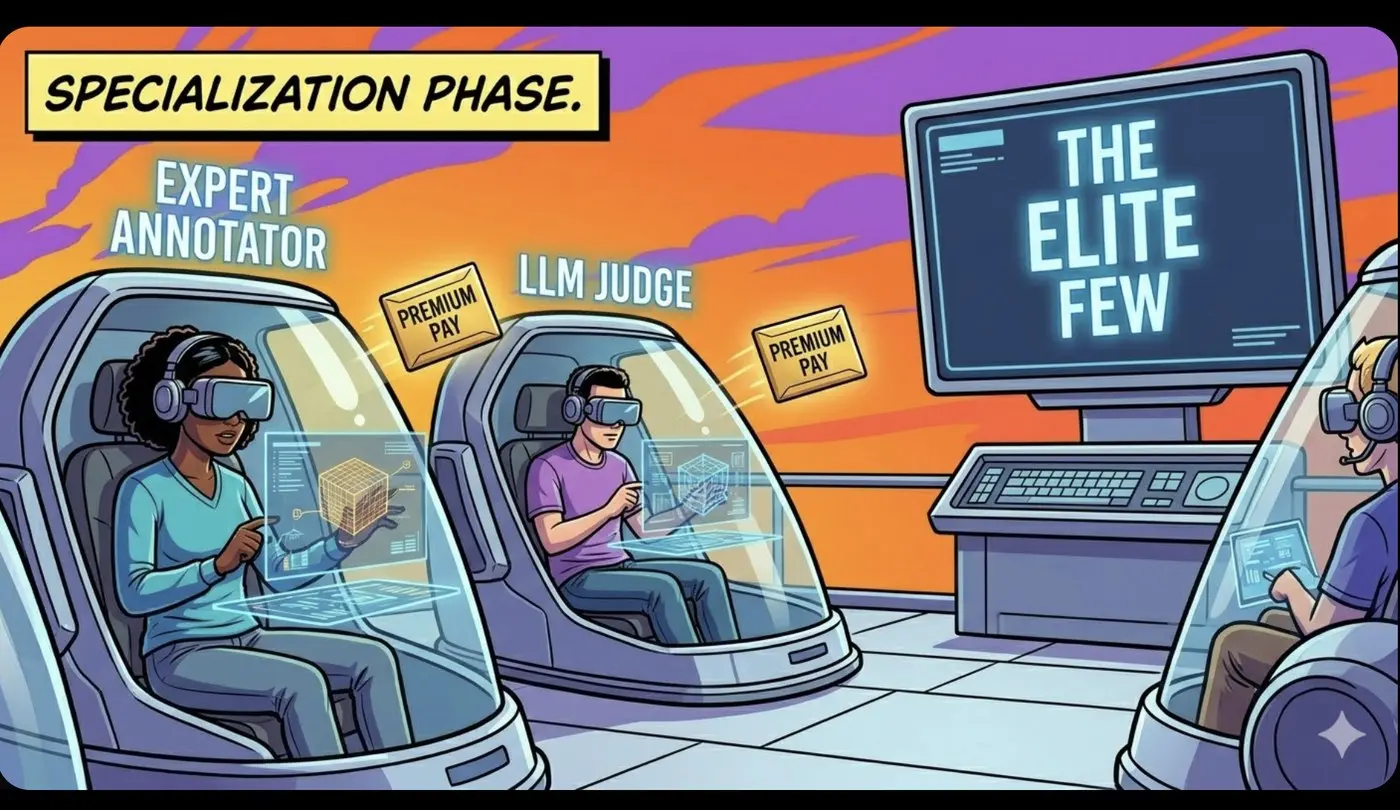
Here's the thing nobody tells you when you start on one of these projects: this is always how it ends.
I've watched the same cycle play out multiple times in this space. A client has a large-scale data need. They distribute work across vendors, ramp up contributors fast, hit their targets. Then the model improves enough that the easy work is saturated — the AI learned what it needed to learn from the beginner tasks — and the contract shifts into a maintenance phase that requires fewer workers doing harder things.
That's not a failure of the platform. That's the lifecycle of an AI training contract. The workers who survive the transition are the ones who saw it coming and were already qualified for the harder tier when the cut happened.
The move right now is not to wait for Aether to come back the way it was. It isn't coming back that way. The move is to get yourself onto the next version of this work before the same narrowing happens there.
DataAnnotation is where I'd start. Telus if you want stability over upside. Alignerr if you have the credentials to qualify for the specialist tracks.
And whatever you do: don't build your income around a single project again. It's very easy to fall into complacency. To treat this work other than what it is meant to be, extra. A side hustle. If you couldn't find anything better when you started, that's fine, but don't stop looking. In the meantime, diversify. 🥚 🧺
Everything we track on Outlier: pay, reviews, and how to apply
Read Next
From the community
Join the conversation — no email needed →What workers are talking about
Comments
Leave a comment
Joshua Drake has worked on AI training platforms for over four years, tracking earnings, sentiment data, and platform stability across Outlier, DataAnnotation, Alignerr, and others. He has a degree in data analytics and runs this site, breakingeven.online and the sentiment analysis used to derive a sense of what is happening in a world often hiding in the shadows.