DataAnnotation & Outlier AI Work Drought: Why Tasks Disappear and How to Survive It
TL;DR: AI gig work follows a predictable 7-phase cycle: discovery, first payout euphoria, lifestyle inflation, golden handcuffs, empty queue panic, pay cuts, and humility. High-paying projects are temporary surges, not salaries. The workers who survive treat every dollar as extra, never quit their day jobs, and diversify across multiple platforms before the queue goes empty — not after.
If you spend enough time in certain corners of the internet—the subreddits devoted to side hustles, the Discords for remote workers, or even just the algorithm-fed side of TikTok—you’ve seen the screenshots.
You know the ones. A stripe connect payout showing $2,500 for a single week. We covered exactly how those unicorn projects work — and why they end. A blurry photo of a laptop on a balcony with a caption like, "I just got paid $45/hr to teach a robot how to write poetry."
It feels like a secret gold rush. It feels like the future. But if you are going to enter the world of AI training, data annotation, and remote gig work, you need to understand that this industry breathes. It inhales cash, and it exhales layoffs. It is a cycle that repeats itself with terrifying precision, and if you aren’t careful, it will break your heart—and your bank account.
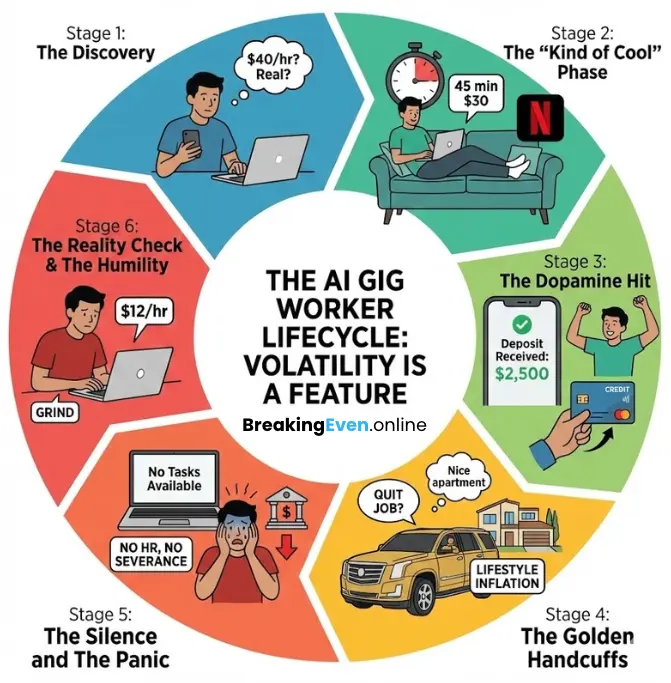
Here is the lifecycle of the AI gig worker. It doesn’t matter if you are at Mercor or Outlier, DataAnnotation Tech or Invisible, if you’ve taken the plunge, or are about to, buckle up because it’s going to be a wild and crazy ride.
Phase 1: Discovering Remote AI Training Jobs
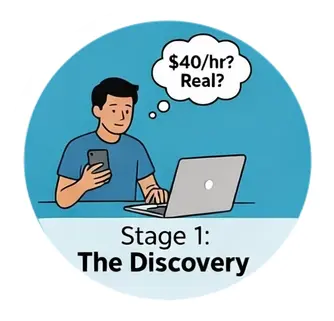
It starts with a whisper. You’re tired after a long day at your "real" job. The commute was awful, your boss was micromanaging you, and the paycheck barely covers rent and groceries. You’re scrolling on your phone, and you see a post. Someone is talking about a platform—maybe it’s for coding, maybe creative writing, maybe fact-checking.
“Is this real?” you think. “$40 an hour? From home? Whenever I want?”
You read the comments. Half the people say it’s a scam; the other half say it saved their life. You feel that spark of curiosity mixed with desperation. You find the link. You create a profile. You spend your Saturday afternoon taking a grueling qualification exam, sweating over instructions that seem slightly ambiguous. You hit submit, close the laptop, and tell yourself not to get your hopes up.
Phase 2: The "Kind of Cool" Phase
A week later, you get the email. "Congratulations, you have been accepted to the project."
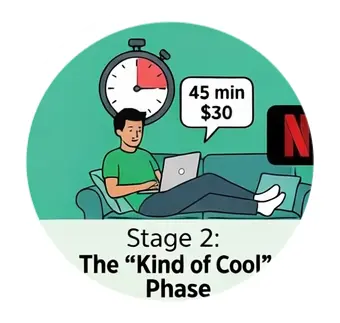
You log in. There are tasks available. You do a few. It’s weird work—rating whether Response A is more helpful than Response B. It’s tedious, but you’re sitting on your couch in your pajamas. You look at the timer. You just made $30 in 45 minutes while watching Netflix in the background.
It feels illicit. You haven’t been paid yet, so a part of you remains guarded. “They’re probably not going to pay me,” you tell your spouse. “This is too easy. There’s a catch.” But you keep working, just in case.
Phase 3: The Dopamine Hit
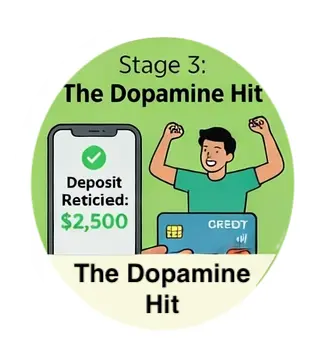
Then, it happens. The notification hits your phone. Deposit Received.
You stare at the banking app. It’s real. You just made more money in your spare time this week than you did in three days at your full-time job. The math starts running through your head. “If I do this for 20 hours a week, that’s an extra $3,000 a month. If I do 40 hours… oh my god.”
You feel like a genius. You feel like you’ve hacked the system. You treat yourself to a nice dinner. You pay off a credit card. You tell your friends, casually, that you’re working in "AI development." You are riding high.
Phase 4: The Golden Handcuffs

Three months go by. The work is steady. The queue is always full. You wake up, grab coffee, and start earning. The money has become a rhythm.
This is the most dangerous phase.
You start to resent your 9-to-5. Why are you waking up at 6:00 AM to drive into traffic for a job that pays you half of what the AI platform pays? You start doing the gig work at your day job. You start calculating your annual salary based on this gig income.
“I could quit,” you think. “I could just do this. I could be a digital nomad. I could buy that new car.”
And maybe you do. You trade in your sensible sedan for an Escalade. You move into a nicer apartment. You stop putting the gig money into savings and start putting it into your lifestyle. You have become reliant on a faucet that you do not control. You have bought a seat on the gravy train, assuming it runs on an infinite loop.
Phase 5: The 'Empty Queue' (EQ) and Sudden Layoffs
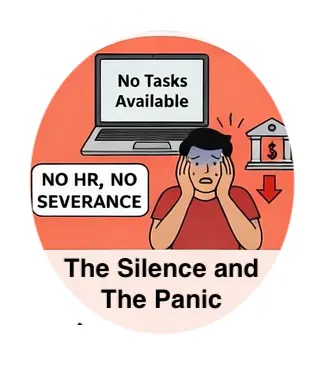
It’s a Tuesday. You log in to work. The screen says: No Tasks Available.
“That’s weird,” you think. You refresh. Nothing. You refresh again. You check the Slack channel or the Discourse forum. The mood has shifted. People are asking, “EQ for anyone else?” (Empty Queue).
Then comes the announcement. It’s corporate-speak. “We are pausing the current workflow to evaluate quality,” or “This project has reached its cap.”
The panic is a physical sensation. It starts in your stomach and moves to your throat. You check your bank account. The car payment is due next week. You just spent your last payout on a weekend trip because you thought the next payout was guaranteed. You spend the next 48 hours scouring Reddit, going through the 6 Stages of AI Ghosting, refreshing the page every five minutes, looking for a workaround, a new project, a lifeline. You realize, with horror, that you have no HR department to call. You have no severance. You are just… out.
Phase 6: The Reality Check

Two weeks of silence pass. You are desperate. Then, an email appears. A new project is available!
You rush to log in. You read the instructions. It’s harder work than before. It requires more fact-checking and stricter citations. You look at the pay rate.
It is 1/4th of what you were making before. This is when you need to swap to a different platform.
Instead of $45/hr, it is $12/hr. Or maybe it’s “pay per task,” and the tasks take 20 minutes but pay $3. You stare at the screen, insulted. “I am a specialized human reinforcement learner,” you think. “I am worth more than this.” This is when you need to swap to a different platform.
Phase 7: The Humility
You click "Start Task."
You do the work. You do it because the Escalade needs gas. You do it because $12 is better than $0. You grind through the lower-paying work, fueled not by the euphoria of Phase 3, but by the anxiety of Phase 5. You are just happy to have something. The dream of easy riches has evaporated, replaced by the grind of the digital assembly line.
The Lesson: Don't Sell the Lifeboat
If you take anything away from this cycle, let it be this: The volatility is not a bug; it is a feature.
In the world of AI training and remote gig work, large-paying projects are temporary anomalies. They are surges. They happen when a company needs a massive amount of specific data right now, and they are willing to pay a premium to get it. Once they have that data, the faucet turns off.
The biggest mistake you can make is treating a "surge" like a "salary."
The people who survive in this industry—and the people who actually build wealth from it—are the ones who refuse to quit their day jobs. They are the ones who treat every single dollar from these platforms as extra.
They don't use gig money to pay the mortgage; they use it to pay down the mortgage principal.
They don't use it to finance a luxury car; they use it to max out their Roth IRA.
They don't assume the project will last forever; they assume it will end tomorrow.
It is difficult to do. When the money is flowing, your brain tricks you into thinking you have reached a new level of normal. Fight that feeling.
Do not be the person caught off guard with a new lease and zero income. Be the person who uses the high-paying months to build a safety net so big that when the "No Tasks Available" screen appears, you can shrug, close your laptop, and go to sleep peacefully.
Be resourceful. Apply to other companies. Keep your profiles active on DataAnnotation, Outlier, Appen, and the rest. Diversify your income streams so that when one dries up, you have another bucket waiting.
Enjoy the ride, take the money, but never, ever forget: The train has brakes, and it stops for no one.
The Mercenary Pivot
The only way to win is to not play by their rules. You need to always be looking for the next opportunity.
Stop Waiting for Tasks. The only way to survive the Empty Queue is to have a backup. The more eggs you have in your basket the better. Make a check list and hit them all up.
Everything we track on DataAnnotation: pay, reviews, and how to apply
Read Next
From the community
Join the conversation — no email needed →What workers are talking about
Comments
Leave a comment
Joshua Drake has worked on AI training platforms for over four years, tracking earnings, sentiment data, and platform stability across Outlier, DataAnnotation, Alignerr, and others. He has a degree in data analytics and runs this site, breakingeven.online and the sentiment analysis used to derive a sense of what is happening in a world often hiding in the shadows.