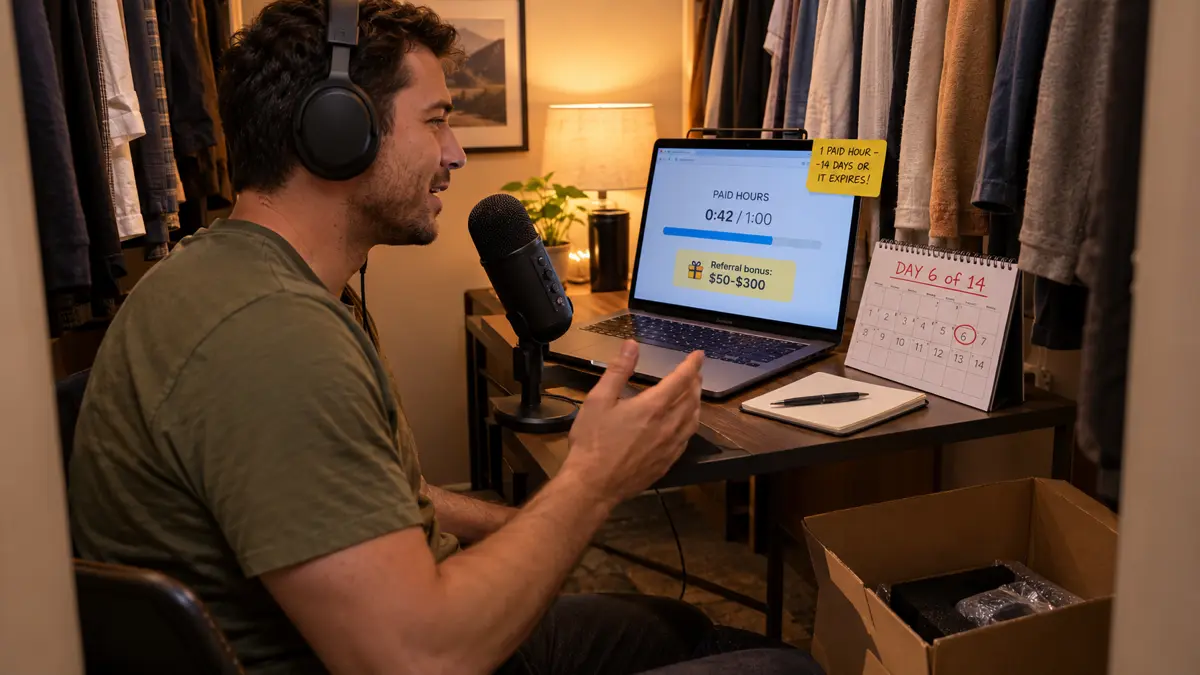
Babel Audio Sign-Up Bonus: $50–$300 After One Paid Hour
TL;DR: Sign up for Babel Audio through a referral link and you get priority onboarding plus a bonus of $50 to $300, depending on the project, once you complete one hour of paid work. That hour has to happen within 14 days of signing up or the bonus expires. Babel onboards fast and pays twice a week. You need a quiet room and a decent USB mic — the mic you can buy at Amazon or Walmart for cheap. The quiet room, unfortunately, they don't stock.
Most of the AI gig platforms I've written about make you earn the right to earn.
Unpaid assessments. Unpaid onboarding modules. A "qualification" that turns out to be three hours of free labor graded by a rubric nobody will show you. Then the queue opens — or it doesn't — and you find out whether any of it was worth it.
Babel Audio runs the other direction. You sign up, you clear an audio check, you start talking to people. And if you came in through a referral link, the platform pays you extra for doing the first hour.
That's rare enough in this space that it's worth walking through how it works — and how people manage to miss it.
How the Babel Audio Referral Bonus Works
Here is the whole deal, without the fine-print fog:
- Sign up through a referral link. (That one is mine. See the disclosure below.) The bonus only attaches to accounts created through one. Signing up from the homepage and asking for it later is not a plan.
- You get priority onboarding. Referred applicants move to the front of the line. On a platform that already onboards quickly, this means you can be recording within days instead of wondering if your application went into a void.
- Complete one hour of paid work. Not one hour logged in. Not one hour waiting for a partner. One hour of paid recording time.
- Do it within 14 days. The clock starts when you sign up. Miss the window and the bonus is gone.
- Collect $50 to $300. The amount depends on the project you're working on. Higher-demand projects carry the bigger bonuses.
Let that ratio sink in. One hour of work, paid at the normal rate, plus a bonus that can be worth more than the hour itself. On the low end, it's a nice dinner. On the high end, it's a car payment.
The catch? The 14 days.
The 14-Day Clock Is Where People Lose It
Here is how the bonus dies. Not with a policy change. With a Tuesday.
You sign up on a Friday, full of good intentions. Onboarding goes quickly. Then the weekend happens. Then your other platform drops a project with a deadline. Then the kids are home sick and the house is never quiet at the same time you're free. You open the dashboard on day 16 and realize you recorded twenty minutes total.
One hour sounds like nothing. But it's one hour of recorded time, and as I covered in the full Babel Audio review, recorded time is not clock time. Calls are short. There's setup, audio checks, picking a topic with your partner, and some waiting between matches while the platform finds someone. Plan on two to three hours of sitting at the desk to bank one paid hour — more if partners are slow to show up.
So treat it like an appointment, not a someday:
- Don't sign up until your setup is ready. The clock starts at sign-up, not when your mic arrives. Order the mic first.
- Block two evenings in the first week. Put them on the calendar like a dentist appointment. If you finish early, great — you have a week of slack.
- Record when your house is quietest. For most people, that's late evening or early morning. Plan around it instead of hoping for it.
Fourteen days is plenty of time. It's also exactly enough time to forget.
What You Need Before You Sign Up
Babel Audio doesn't care about your degree, your coding skills, or your ability to grade a chatbot's essay on Kant. It cares about two things: whether you can hold a natural conversation, and whether your audio is clean.
The conversation part, you've been practicing your whole life. The audio part is where people get stopped.
A decent USB microphone. Babel runs an automated audio check, and it is not forgiving. Laptop mics fail it. Bluetooth earbuds fail it. Most gaming headsets fail it. You don't need a studio rig — a plain USB condenser mic does the job, and Amazon and Walmart both carry solid ones at good prices. If you're shopping, look for a cardioid USB condenser (it picks up what's in front of it and ignores the rest of the room) and skip anything Bluetooth.
A quiet space. This one you can't order online.
The mic hears everything you've trained yourself to tune out — the refrigerator hum, the fan, the neighbor's dog, the HVAC clicking on. A walk-in closet full of clothes is an underrated recording booth. A bedroom at midnight works. A kitchen during dinner does not.
If your home has a toddler, a barking dog, or a partner who takes speakerphone calls in the next room, be realistic about when you can record — and go back and read the 14-day section again.
Why Babel Is Worth Having in Your Rotation
Let's talk about what you're signing up for after the bonus.
Babel pays you to record natural conversations with other workers — the kind of back-and-forth that voice AI is trying to learn. Pick a topic, talk, don't share personal information. The rules are stated up front and enforced consistently, which, if you've spent any time on the platforms in our empty-queue coverage, you'll recognize as a minor miracle.
Onboarding is quick. No week-long assessment gauntlet.
Pay lands twice a week. Payouts go out through Dots, no minimum balance, no thirty-day hold. You're not waiting a month to find out whether your work was approved.
It's a different skill. Your Outlier and DataAnnotation work runs on your reasoning. Babel runs on your voice. When the text platforms go quiet — and they will — a voice platform is an income stream that doesn't dry up at the same time.
Here is the uncomfortable truth about this industry: no single platform is a job. They're faucets, and someone else's hand is on the handle. The workers who make it through the droughts keep two or three platforms live at all times. Babel is one of the easiest to keep live, and the referral bonus pays you to set it up.
The Referral Disclosure
The link below is my referral link. Using it costs you nothing, and it's the link that gets you priority onboarding and the bonus. I may also receive a referral bonus when you complete your hours — that's how referral programs work, and you should know it before you click.
And the standing rule for this whole space: if anyone ever asks you to pay money to apply for AI training work, walk away. Legitimate platforms pay you. Not the other way around.
Sign up for Babel Audio with priority onboarding →
Order the mic. Find the quiet. Book the hour. Then start the clock.
New to Babel? Start with the full Babel Audio review for pay rates and what the calls are really like. Weighing it against text-based work? Outlier vs. Babel Audio breaks down which one fits your week. And if you want the whole market in one place, here's what every AI training platform pays.
Everything we track on Babel Audio: pay, reviews, and how to apply
Read Next
From the community
Join the conversation — no email needed →What workers are talking about
Comments
Leave a comment
Joshua Drake has worked on AI training platforms for over four years, tracking earnings, sentiment data, and platform stability across Outlier, DataAnnotation, Alignerr, and others. He has a degree in data analytics and runs this site, breakingeven.online and the sentiment analysis used to derive a sense of what is happening in a world often hiding in the shadows.