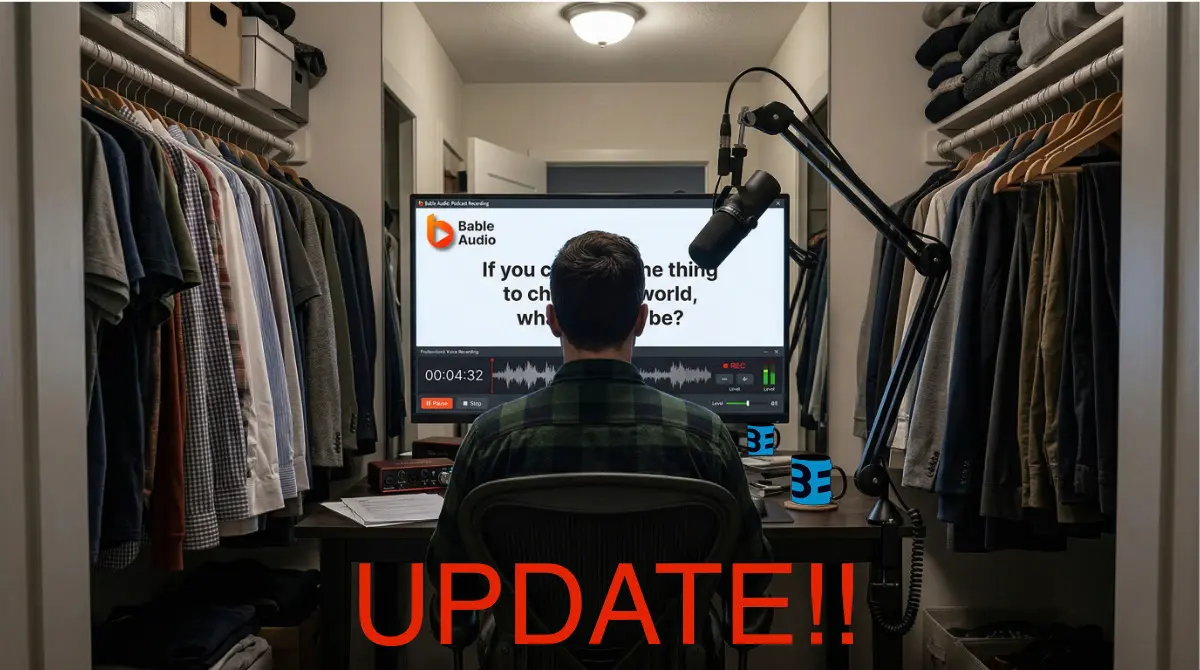
UPDATE! Babel Audio Review: The AI Gig That Wants Your Voice, Not Your Brain
TL;DR: Babel Audio pays $17.50/hr base to record 15-minute conversations for voice AI training, with incentives pushing effective rates to $20+/hr. Payouts are twice weekly via Dots. You need a USB condenser microphone and a genuinely quiet room — Bluetooth earbuds and laptop mics fail the automated audio check. Realistic new-worker earnings are ~$14/hr, climbing to $20+/hr once you optimize your setup.
The AI gig economy has a persistent type problem.
Every major platform — Outlier, DataAnnotation, Alignerr — is fundamentally competing for the same kind of worker: someone who can think critically, write clearly, and evaluate complex AI outputs under pressure. The barrier to entry is mental. The ceiling depends on your credentials.
Babel Audio is not that platform.
Babel Audio wants your voice. It wants the way you pause before you answer a question, the filler words you use when you're stalling, the natural overlap when two people talk past each other. It wants the biological, unpredictable, beautifully messy reality of human conversation — because that's what the next generation of voice AI is trying to learn.
If you can hold a natural conversation and you own a decent microphone, you are, at minimum, an applicant. Whether you're a good worker is a different question, and the answer depends on things the job listing won't tell you.
What Babel Audio Actually Pays
The advertised range in 2026 starts at $17.50/hr. That's the number to plan around.
If you put in the hours and your quality holds up, you become eligible for incentives that push your effective rate meaningfully above that floor. Hit the weekly challenge — ten or more recorded hours in a single week — and Priority Pay kicks in. I've seen community reports of $50/hr projects appearing on the platform, but treat those the way you'd treat any unicorn in this space: real, but not something to build a budget around.
Update: Looks like the unicorns have arrived. Current projects starting at $50/hr. Now that said, it is $50/recorded hour. These are 5 minute calls. I'd say we spend 2-3 minutes getting set up, going through the audio checks, chatting/deciding on a topic. On top of that, you will spend some time waiting — there's not always someone available and that can take a while. I'd say on average expect to take home $25-$27/hr.
Payouts happen twice a week through Dots. No minimum balance. No thirty-day holding period. The money moves when the session is approved.
Cake
You might be thinking: all I have to do is talk to someone? This is cake.
The core task is a 15-minute recorded conversation with a partner. You hit "available," a random partner gets matched to you, and you say your hellos before the recording starts. Then you pick a topic together from a list of available options. No personal identifiable information allowed — and from what I can gather, that rule is strictly enforced.
Cake, right? Sure. Until your partner's phone goes off mid-sentence. Until their fire alarm starts shrieking and you both sit there in silence, trying to figure out if you acknowledge it or just power through like adults. Until you simply don't vibe with the person on the other end and fifteen minutes feels like an eternity.
Or maybe, like me, you're an introvert who signed up hoping that sheer economic necessity would finally transform you into a social butterfly — someone for whom effortless conversation just happens.
It doesn't. Luckily, I'm a realist, so I expected as much.
This is voice AI training for the next generation of agentic voice assistants — the shift away from "Hey Siri, set a timer" commands toward systems that can hold a real back-and-forth. Think customer service AI that doesn't make you want to hang up. Think a medical transcription assistant that understands what a doctor means when they trail off mid-sentence.
Growing specialty categories on the platform include:
- Medical/Healthcare Mock Consultations — patient-doctor dialogue simulations
- Technical Support Simulations — scripted frustration, which some people are naturally gifted at
- Multilingual Code-Switching — English combined with Spanish, Turkish, and others. If you're bilingual, Babel is quietly one of the better-paying uses of that skill in the gig economy
The Gatekeeper Nobody Mentions Until You Fail
There is one thing standing between you and your first approved session, and it is not your conversational ability.
It's your microphone.
Babel Audio runs an automated audio quality check during onboarding. It's not a human listening to your voice — it's an algorithm scanning your recording for background hiss, fan noise, room reverb, and low-quality input signals. Bluetooth earbuds fail this. Built-in laptop microphones fail this. If your audio quality doesn't clear the threshold, feedback is immediate, and if you can't correct it, you aren't a good fit for the platform.
Sound is more difficult than we all give it credit for. Every sound you've trained yourself to tune out in daily life — the hum of a refrigerator, the distant traffic, the click of an HVAC vent — comes through loud and clear on a condenser microphone. Ask any podcaster or voice actor. They will all tell you the same thing: the room matters as much as the equipment.
The setup that consistently clears Babel's check:
- A dedicated USB condenser microphone (Blue Yeti, Audio-Technica AT2020, or equivalent — doesn't need to be $500, but it needs to be better than a built-in)
- A genuinely quiet room — not "quiet enough," but actually quiet. Record at midnight if you have to.
- No Bluetooth anything in the audio chain
If you already have this setup for streaming, podcasting, or voiceover work, Babel Audio becomes one of the easiest applications you'll ever fill out.
What "Feedback" Actually Means
Every time you get flagged — for background noise, dead air, or one person dominating the call — it's not just a note. It affects how many calls you're allowed to take per day.
New workers start at three calls per day. Nail your quality and that number goes up quickly. Struggle with it and it stays where it is. The rules are clear, they're communicated repeatedly, and if you ever find yourself losing access to the platform, there will be no question in your mind as to why — which is a rarer courtesy than it should be in this industry.
This is worth sitting with before you calculate your effective hourly rate. Between setup time and pre-call topic coordination, you're realistically looking at $14/hr in practice as a new worker. That number climbs as you optimize your space and your calls get more efficient. Hit the weekly challenge consistently and you're looking at $20/hr or better.
The learning curve is real, but it is a short one. Most workers report their feedback stabilizing after the first few sessions once they've figured out their space and what a smooth call actually sounds like on the platform.
Compared to Everything Else in the Gig Economy
Babel Audio is not trying to be Outlier. It has no interest in your reasoning ability, your credentials, or your capacity to grade a large language model's response to a complex philosophical prompt. There are no evaluation rubrics. There are no "Enablement Centers" with unpaid training modules.
There is a microphone. There is a conversation. There is a recording. You deliver the clearly stated deliverables, and everyone goes home happy.
This is the platform everyone with a USB mic and a quiet walk-in closet should already have in their toolbelt. There will come a time when you're the one staring at the empty queue, and as safety nets go, Babel is one of the easiest to set up in advance.
It will not make you $3,000 in a week. It will make you $200 in a slow week and $400+ if you put the time in. It isn't a mindless job, but the rules are clear, the expectations are stated upfront, and you know exactly what you're getting paid. That alone beats out most of the unpaid "training" and "onboarding" that the rest of these platforms put you through.
For some people, that is exactly the trade they want.
Who Should Apply
Babel is probably right for you if:
- You already own — or are willing to invest in — a proper USB microphone setup
- You're between projects at Outlier or DataAnnotation and need consistent income while you wait
- Your living situation includes a genuinely quiet recording space
Babel is probably wrong for you if:
- You're working from a home with children, pets, or a needy spouse. Shouting "I AM ON THE PHONE" is not a substitute for soundproofing.
- It's hot and you need a fan on
- You need high-variance, high-ceiling income — Babel is a steady base, not a lottery ticket
The Referral Situation
The apply link below is a referral link. It costs you nothing, and I could get a small bonus if you work a certain number of hours. On that note: if anyone ever asks you for money to apply for a job in this space — don't. Just don't.
Looking for a full breakdown of what AI training platforms pay across every task type? We ran the numbers.
Everything we track on Babel Audio: pay, reviews, and how to apply
Read Next
From the community
Join the conversation — no email needed →What workers are talking about
Comments
Leave a comment
Joshua Drake has worked on AI training platforms for over four years, tracking earnings, sentiment data, and platform stability across Outlier, DataAnnotation, Alignerr, and others. He has a degree in data analytics and runs this site, breakingeven.online and the sentiment analysis used to derive a sense of what is happening in a world often hiding in the shadows.