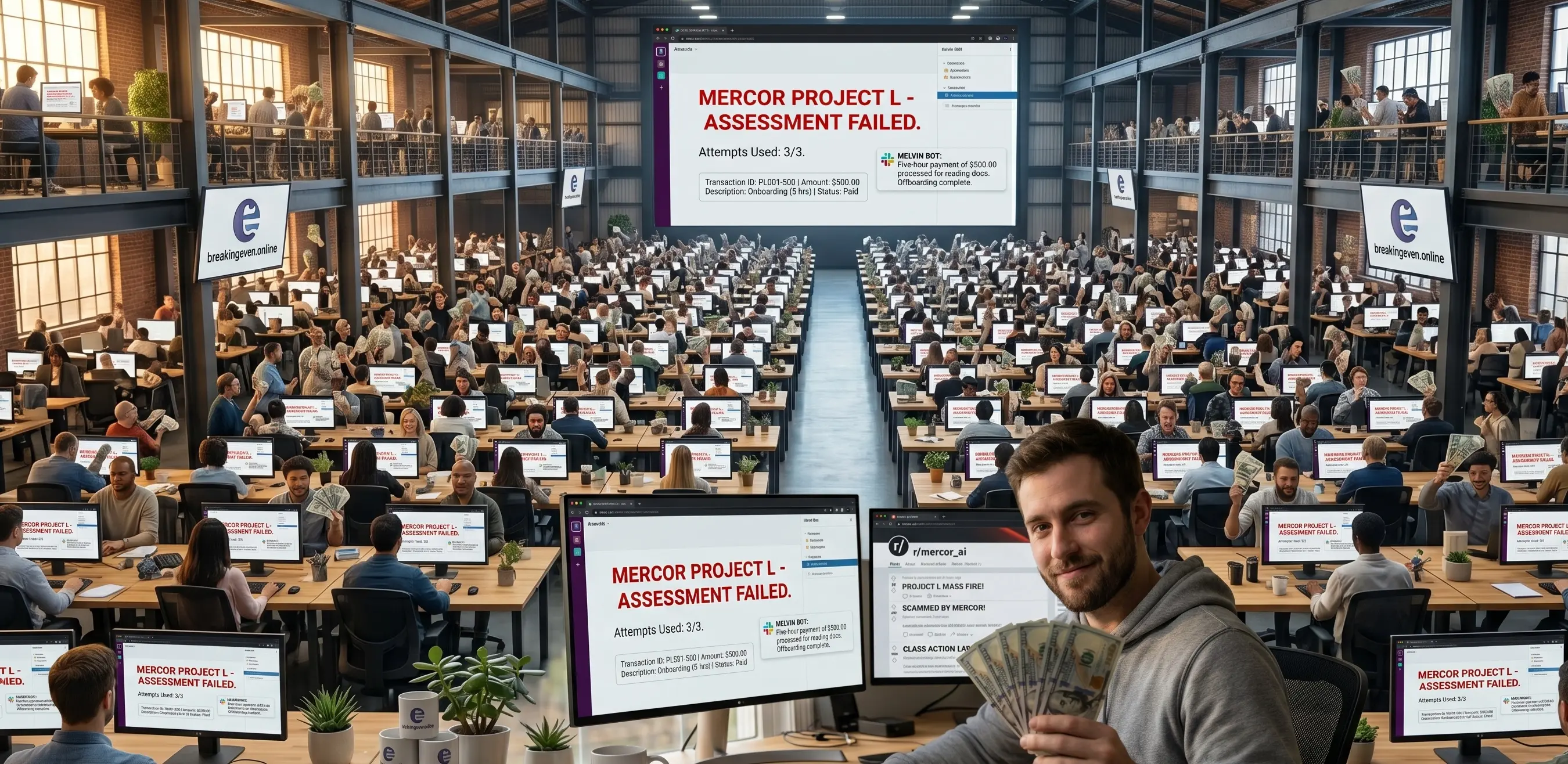
The Quiz Is Not the Work: Two Workers Tell What Actually Happened Inside Mercor's Project L
TL;DR: Mercor's "Project L" — the Generalist Expert role that scaled past 11,000 contractors in a single Slack channel — is being framed on Reddit as a coordinated scam. From two contractors who are or were on the project, that story does not hold. Onboarding paid $100/hr to read documentation that genuinely contained the answers. The "quiz" was a multiple-choice test with three paid attempts on the same form. The no-hoarding rule that got people offboarded was explicit in the paid-to-read docs. And when promised weekend work didn't materialize, Mercor paid out five hours of compensation to everyone who had passed the quiz. If you got booted from Project L, you almost certainly took home five hundred dollars for some light reading. That isn't a scandal. That is the floor of the gig economy, and most of the platforms below it would never have given you that floor.
On May 7, the alerts feed on this site flagged a sentiment_crash event on Mercor — a 15-point drop in 24 hours. Sentiment had been recovering for two weeks. Then it wasn't. The crash hasn't resolved.
If you've been reading our April newsletters, you saw something different. You saw a line that said Mercor's community had gone completely silent post-breach. That was true in April. It is wildly untrue now. As of this morning, r/mercor_ai has logged 100 posts in the last 2.81 days — roughly 35 posts a day, and accelerating. The feed is hitting its 100-entry cap inside three days. That is not a silent sub.
The breach is also not the topic anymore. Only four of those 100 posts mention the data leak directly. The conversation has moved on to something bigger, and the framing has hardened fast: that Mercor scaled a project called "Project L" past 11,000 contractors, demanded unpaid screening work dressed up as a quiz, lied about manual grading that was actually automated, and offboarded thousands without warning or recourse.
I reached out to two contractors who are or were on the project. What they told me is not the story Reddit is telling.
What Marcus Saw From The Inside
Marcus is on his second year working Mercor projects. He got the Project L offer on May 1, cleared his background check on the following Tuesday, and is one of the contractors who passed the assessment and is still working.
The first thing he found in the system, he said, was an instruction to bill up to five hours at the project rate — $100 per hour — for reading the documentation, setting up his accounts, getting added to Slack, and finishing basic onboarding. Five hundred dollars in onboarding pay before he answered a single project task.
"I read every word," he told me. "I'm a slow reader at the best of times. At a hundred dollars an hour, I was the slowest reader on the planet. I went through the docs twice."
Two days later there was an onboarding call. Two coordinators. About 2,000 contractors on the line. The coordinators went through the basics, answered a handful of questions, and mostly directed people back to the documentation because the documentation had the answers.
"I felt a little thrown out to the wolves on that call," Marcus said. "I also knew there was no version of this where two coordinators were going to hand-hold two thousand contractors. That isn't how piecework projects scale. The two of them did a decent job, all things considered."
Then the client published the assessment. You had to pass it before you could touch the work.
The Test Everyone Failed On Purpose
Marcus told me he had taken a Mercor assessment once before and walked out convinced he had aced it. He had not aced it. That memory was sitting on his shoulder when he sat down for the Project L quiz, so he took it seriously. Read every question twice. Was scared.
He failed it the first time.
Three paid attempts. Same form. Reddit is not mentioning this. You're not starting from scratch on each try — you can see which answers you got wrong and try again. Marcus corrected the questions he had missed, took the test a second time, and passed.
By the time he passed, the Slack channel had grown to about 8,000 people. Two days after that, it was over 11,000 and rising. At some point shortly after, moderators took the Slack private. The number of contractors who had cycled through Project L by then was substantially higher than the 4,000 figure dominating Reddit.
1,489 hires inside one month is real. 800 offboarded in a wave is also real. But 800 out of more than 11,000 cycled through is not the same story that gets quoted in the rage posts. It isn't even close to the same story.
Five Things Reddit Got Wrong
Walking through the viral claims one at a time, with the operational reality from Marcus's account:
1. "The quiz is unpaid screening labor." No. Onboarding paid $100/hr to read the source material the quiz was drawn from. The quiz itself is multiple choice. The answers are in the documents you were paid to read. If you skipped the documents and then failed the quiz, you were still compensated for the reading time. That is structurally fairer than 90% of the gig market.
2. "Grading took 18 hours instead of 48 — proof it was automated." Of course it was automated. It is a multiple choice test. There is no version of "manually grading" a 4,500-person multiple choice quiz that takes 18 hours, 48 hours, or 48 days. The 48-hour window Mercor quoted was padding, not a methodology claim. Anyone who has taken a Scantron in high school understands the math.
3. "One mistake and you're out." No. Three paid attempts on the same form, with answer review between attempts. If you've never seen a paid retake with answer review in this industry, that's because this industry rarely offers one.
4. "No human support — Melvin bot won't escalate." Two coordinators were managing onboarding for an effectively unlimited contractor pool. That is a staffing ratio, not a coverup. They consistently directed people back to the documentation because the documentation had the answers — and they were not wrong about that.
5. "I got booted for randomly claiming a second task." That one is the easiest to debunk because the contractor who posted it said in his own words that he hadn't read the rule. The no-hoarding rule was explicit in the documentation. It was repeated out loud on the onboarding call. He got paid to be told. He chose not to listen. The platform did exactly what it said it would do.
What Mercor Did That Surprised Marcus
The line in this whole story that has been getting the least attention deserves the most: Mercor paid people for work that never happened.
Promises were made in the project Slack about work being available over the weekend. The work did not materialize. Mercor's response, communicated directly to everyone who had passed the quiz: a five-hour payout at the project rate as compensation for the gap. No filing required. No dispute. No waiting. Five hours times $100 is $500 in your account for a weekend you didn't work.
"I have my doubts about hiring eleven thousand people up front for a project that may only have had seven thousand tasks," Marcus said. "But that right there? Pre-emptively, voluntarily compensating people for a weekend the platform couldn't deliver? That isn't something I'd expect from anyone in this market."
I've worked Outlier. I've watched the Outlier playbook on empty queues — which is to say no playbook at all. You sit at your dashboard, you refresh, and you eat the lost hours. DataAnnotation doesn't pay you for the day the project quietly pauses either. Mercor's behavior here is the exception in a market where the rule is silence. That is not something I would have written down before this week. It is something I am writing down now.
Dave Got Booted And Walked With Five Hundred Dollars
Dave is a friend. He has been doing gig work for years and his eggs are stashed in baskets all over the city — that is genuinely how he describes it. He got the Project L offer in the same wave Marcus did. He's the kind of worker most platforms count as the model contractor: shows up, does the work, doesn't fight the system.
He failed all three attempts at the assessment. Offboarded by the end of the week.
When I asked him what he made of it, his answer was the entire thesis of this article in three sentences.
"Got booted," he said. "Got paid. Moved on."
He pulled $500 from his Mercor account for the onboarding time, walked into his backup queue on Babel Audio that night, and didn't think about Project L again until I called him. He isn't on Reddit grieving. He isn't filing a complaint. He read the docs, took the test, didn't pass it, and treats the outcome the way a card player treats a bad hand. Next deal.
"$100 an hour jobs are a unicorn," he told me. "Even if you only get paid for onboarding and the test, you take the five hundred and you say thank you for the opportunity. The people grieving on Reddit got the same five hundred. They're just choosing to spend it on outrage instead of groceries."
This is the response I wish more contractors had to a failed assessment, and the response that almost nobody has, because the response is downstream of whether you spent the last three years setting yourself up to absorb a missed gig without flinching.
The Grief Cycle Looks Like A Class Action
Failing a test that pays $100/hr is a real loss. Failing one and feeling like you weren't good enough is worse than the missed money. I'm not a monster. Losing this kind of offer does qualify as a small grief event, and like any grief event it has stages.
The stage Reddit captures is anger.
The pattern looks like this. Person fails the quiz. Person feels the floor drop out. Person opens Reddit. Person finds a hundred other people in the same state. The validation feels real, because it is real — those people are also angry. Then someone posts a story that frames the platform as the villain instead of the test. The story gets traction because everyone in the thread wants it to be true. The next post escalates. Within 48 hours, a multiple-choice quiz on documented material becomes "unpaid screening labor for an automated system that lied about manual grading."
Some of those people are going to scroll Reddit for two more days and then start applying somewhere else. Most of them. They'll be fine. The ones who concern me are the ones who plant a flag in the abuse narrative and stay there — because the math on a $500 onboarding payout for a quiz they didn't study for is actually pretty good, and the longer they spend defending the trauma frame, the longer they're not earning on Babel Audio or DataAnnotation or Handshake AI or any of the platforms that are actually paying this month.
Your five minutes of woe-is-me time is up. Get back on Babel Audio and make some calls.
Where The Story Has Teeth
None of this means there are no legitimate concerns under the noise. A short list of what is worth watching:
The intake-to-attrition ratio. Bringing in over 11,000 contractors for a finite-task project means high attrition by design. Even when every offboarding decision is rule-based and fair, going from "I have an offer" to "I'm out" inside a week is stressful, and stress shows up as panic posting whether or not the panic is warranted.
The information asymmetry. Once the Slack went private at 11K+ members, the public-facing story (Reddit) and the actual project-floor reality (private Slack) diverged sharply. Anyone reading the Reddit thread is working from a partial map drawn mostly by the people who got cut. That's a structural problem for journalism on this story, ours included.
The Hunger Games dynamic. For contractors who are still on the project, when tasks do come through, they come in waves. Here one minute, gone the next. Wait two minutes and repeat. Not unique to Mercor — every piecework platform runs this way — but the scale of the contractor pool makes it more pronounced.
The transparency question. The 48-hour-grading promise wasn't necessary. Mercor could have said "your quiz will be auto-graded immediately" and saved themselves the credibility hit when it was. Small framing choices like that one are why a true automated process is now being misread as a coverup. The cost is reputational, and reputation lost on theater is harder to win back than reputation lost on substance.
If You Just Got A Project L Offer
The contract is real. The pay rate is real. The platform is operating within the rules it published. If you're considering accepting:
1. Read every word of the documentation. They are paying you to read it. The single biggest predictor of who passes the quiz is whether they actually read the docs that contain the answers.
2. Treat the assessment as the gate it is. Three attempts is generous, but it is not infinite. Slow down. Be scared. Read each question twice.
3. Don't hoard tasks. The rule is explicit. It will be enforced. Workers have been offboarded for it on Day 1 of having access. The platform told you.
4. If you fail and get offboarded, you almost certainly take home $500 for the onboarding hours alone. Pocket the $500 and move on. $100/hr jobs are a unicorn. Even one paid afternoon of light reading at that rate is a win against the rest of the market.
5. Diversify before you start, not after you fail. Stashed eggs in many baskets is the entire premise of survival in this industry. If you've already done the diversification work, getting offboarded from Project L isn't even a grief event. It's a small Wednesday.
Notes On Our Own Data
A short audit of our own coverage, in public, because the story this week is partly about us.
The pipeline flagged the Mercor sentiment_crash on 2026-05-07 — a 15-point drop in 24 hours. The alert is real and unresolved. What I want to be careful about, and what we hadn't been thinking about clearly until this week, is what that alert is actually measuring.
It is measuring grief volume on Reddit. It is not, strictly, measuring platform health.
Those are not the same signal. A platform that quietly improves its workflow and has an angry cohort of failed candidates will look exactly like a platform that is collapsing. The sparkline tilts down either way. The next iteration of our scoring needs to separate "users are loudly upset" from "platform is materially failing" — those are different stories with different prescriptions, and right now the pipeline is conflating them.
The April newsletters on this site published the line "Mercor's community has gone completely silent" three weeks in a row. By the time you read those newsletters, that line was already wrong. The pipeline had updated. The MDX hadn't. That's a content workflow gap we own, and the fix is to put a freshness check on any published platform claim and auto-flag it for review when the underlying data has moved.
Side finding for the next pipeline pass: Mercor's time-tracking tool is now Insightful, not Hubstaff. Anything in our cross-platform Hubstaff coverage that's been applied to Mercor specifically needs an asterisk.
The Punchline
The thing I keep coming back to, after talking to Marcus and Dave, is that getting paid $500 for light reading is not a tragedy. It is a $500 bill in your pocket. The people who walked away from Project L with nothing but the onboarding deposit and a thirty-minute multiple-choice grievance are doing better, financially, than half the workers on every other platform on this site in the same week.
As everything changes in this industry, the data will tell you when something big is happening — and when it does, you are going to want to ask questions before you take the loudest answer at face value. The loudest voices in any community are not the representative ones. They are the angriest ones, and they are angry for reasons that are real to them and not always true about the platform.
If you have stashed your eggs around the house instead of in that one god-forsaken basket, you might not have anything to grieve over at all. You got paid five hundred dollars for some light reading. That is not work. That is a Tuesday.
Track Mercor sentiment in real time on the Mercor platform page. For a wider read on which platforms are paying this month, see the live heatmap. New to this world? When the Robots Stop Paying is the map of the cycle most of these stories are about.
Read Next
Comments
Leave a comment
Joshua Everett has worked on AI training platforms for over four years, tracking earnings, sentiment data, and platform stability across Outlier, DataAnnotation, Alignerr, and others. He has a degree in data analytics and runs this site, breakingeven.online and the sentiment analysis used to derive a sense of what is happening in a world often hiding in the shadows.