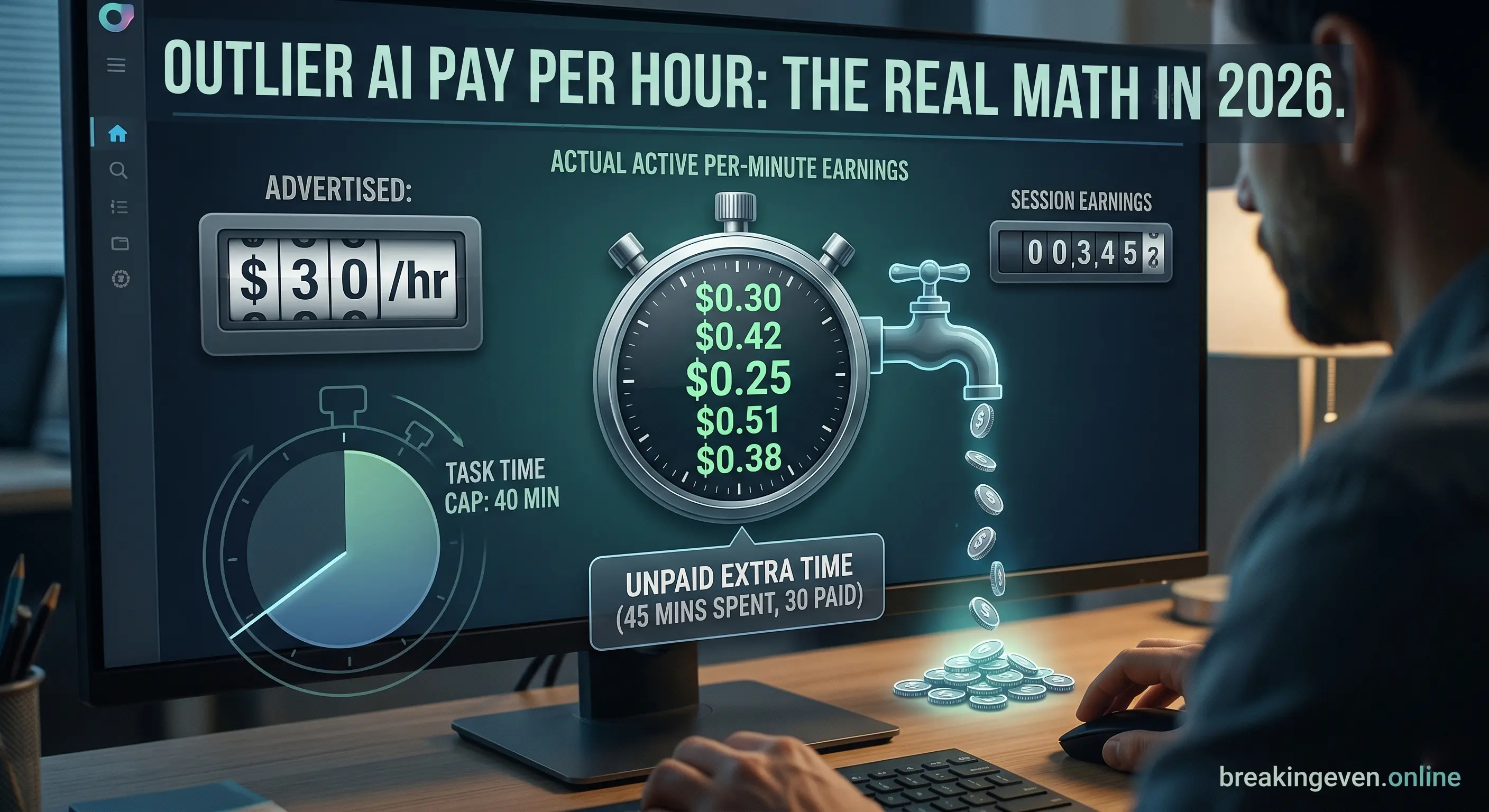
Outlier AI Pay Per Hour 2026: How Much Do You Actually Make?
TL;DR: Outlier AI effectively pays $12–$45/hr depending on task type. Most workers land $18–$28/hr on standard RLHF tasks. Coding and expert-tier tasks pay $35–$60/hr for credentialed workers. New workers on bulk tasks often see $12–$16/hr for the first few weeks. Rates are lower in 2026 than they were a year ago.
The Reddit post had been up for six hours when I found it at midnight.
Someone had posted a screenshot of their Outlier AI dashboard — a week's worth of tasks, everything broken out by type. They'd done the math in the comments: 31.5 hours logged, $687 paid. That's $21.81 per hour. The top comment was someone claiming $45/hr. The second comment was someone who said they'd never broken $14/hr. Three people called the original poster a liar. Four asked how to sign up.
The argument had been running for hours, and here's the thing: everyone was right.
That is the Outlier AI pay situation in 2026 — wildly different real numbers, none of them wrong, all of them useless without context.
The Foundational Problem
Outlier AI doesn't pay per hour. It pays per task.
This matters, because "per task" turns every single worker into a human A/B test. Two workers sit down at the same time, log a four-hour session, complete the same category of tasks — and one earns $80 and one earns $140. Same platform. Same task type. Different speeds, different task selection, different project access.
The "how much does Outlier AI pay per hour" question is actually three separate questions:
- What is the effective hourly rate on standard annotation and RLHF tasks?
- What is the effective hourly rate on specialized, higher-credential tasks?
- What does your specific situation actually pay?
Questions 1 and 2 I can answer. Question 3 requires you to track your own sessions for two weeks before you'll have a real number.
What Outlier AI Actually Pays: The Real Ranges
Here's what community data and platform discussions show for effective hourly rates in 2026, calculated by dividing actual session earnings by actual session time:
| Task Category | Effective Hourly Rate | Notes |
|---|---|---|
| Bulk micro-annotation | $10–$16/hr | High volume, low per-task rates, queue-dependent |
| General RLHF / conversation review | $18–$28/hr | Most common task type, widest availability |
| Long-form content evaluation | $20–$32/hr | Time-intensive per task, but higher task rates |
| Code review and debugging | $28–$45/hr | Requires verified coding background |
| Expert-tier (legal, medical, scientific) | $35–$60/hr | Credential verification required, inconsistent availability |
The column that matters most is "Notes." Especially that last one: those higher-paying categories require professional credentials and going through Outlier's verification process for those credentials. If you haven't done that, you are not seeing those task pools. You are seeing the bottom third of this table.
Why the Range Is This Wide
The same task rate produces wildly different hourly earnings depending on five variables that have nothing to do with how smart or hardworking you are.
Speed. Outlier posts estimated task completion times. Community consensus: those estimates run 30–50% optimistic. A task labeled "20 minutes" takes most workers 25–35 minutes. That's not a rounding error — across a 4-hour session, it's the difference between $22/hr and $16/hr.
Task selection. When a high-rate task appears in the queue, multiple workers see it simultaneously. If you grab it in three seconds, you do the task. If your refresh cycle runs ten seconds slower, it's gone. Fast selectors consistently earn 15–20% more per session than slower ones, even on identical task types.
Project access. Workers assigned directly to projects earn differently than workers browsing the general task queue. Project assignment usually means better rates and more consistent volume. Getting there requires a track record. You don't start there.
Time of day. Task volume fluctuates with client activity on the other end. Workers who found their optimal windows report significantly different queue quality than those logging in at random.
The learning curve. Your first ten hours on any task type are your slowest. Your fiftieth hour on the same task type is completely different. The effective hourly rate you earn in week one is not what you'll earn in week eight — assuming there's still a queue in week eight.
The Hidden Time Tax
Here's the number Outlier never shows you: the time you spend not working but still tied to the platform.
Queue-monitoring time. You log in, find nothing available, check again in 15 minutes, check again. That time pays exactly zero.
Training and guideline time. When a new project type opens, there are orientation materials, calibration tasks, instructional videos. Some of that pays. A lot of it doesn't.
Dispute resolution time. A task gets returned for revisions. You re-read the guidelines, figure out what went wrong, redo the work. If the re-submission doesn't pay, you donated that hour.
Real workers who track their full platform engagement — not just session time, but total time spent on platform business — often find their effective hourly rate drops 20–30% from what the dashboard math suggests. The dashboard shows $25/hr. Life shows $18/hr. Both numbers are honest.
This is the reality we covered in when the robots stop paying: the faucet runs when it runs, and every minute you spend waiting for it to run counts against your real income.
What New Workers Actually Earn in the First Month
Forget the $45/hr screenshots for a moment.
A realistic expectation for a new Outlier worker starting today:
- Weeks 1–2: $12–$18/hr while learning task types, building speed, understanding which tasks to grab and which to skip
- Weeks 3–6: $18–$25/hr as the workflow becomes familiar and task selection sharpens
- Month 3+: $22–$35/hr if you're on a stable project with consistent availability — or lower if there's been a project wind-down and you're back on the general queue
The workers who report $40+ are almost always on specialized projects — coding, legal analysis, expert verification — that they qualified for specifically. Those don't show up in the general queue for everyone.
The workers who report $10–$12/hr are almost always new, or on a low-rate project during a thin period, or both.
How Outlier Compares Right Now
In May 2026, here's where Outlier sits against the alternatives on effective hourly rate:
DataAnnotation: $15–$25/hr on standard tasks. More consistent availability than Outlier right now. No surveillance software controversies in recent data. Current status: Operational.
Mindrift: $18–$28/hr for qualified writing and language workers. Narrower task types. Worth running in parallel if Outlier's queue is empty for you.
Alignerr: $8–$18/hr reported. Platform stability issues. Not the primary move for most workers right now.
Babel Audio: Per-utterance structure makes per-hour calculations variable. Some fast readers report solid rates; others find the math doesn't work for them. Check the comparison before investing setup time.
Outlier has the highest ceiling of the mainstream platforms if you can reach the specialized tiers. It also has one of the lowest floors if you're stuck on bulk micro-tasks during a thin project window. The volatility is not a bug — it is how this industry is built.
The Declining Trend
Rates have moved down. Not dramatically, not a cliff — but the floor is lower now than it was twelve months ago.
The high-paying specialist ceiling hasn't changed much, but access to those projects has narrowed as more credentialed workers joined and task volume didn't scale proportionally. The Aether project wind-down reduced available hours for a wide subset of workers. That reduced volume concentrated competition for remaining tasks, which means the average worker sees fewer high-quality tasks per session.
The realistic expectation in May 2026 is not what this platform paid in May 2025. If someone quotes you a rate from a year ago, it's not necessarily wrong — it's just not the current number.
Is It Worth It?
At $18–$25/hr remote and flexible, yes. It's real money. The algorithm doesn't care about you, won't give you benefits, and will drop you without warning — the algorithm will never love you back — but neither does a warehouse shift, and this one doesn't require steel-toed boots or a supervisor three feet behind you.
The mistake is treating the high-end number as the expected number. The $45/hr stories are real. They are not the average. They are not guaranteed. They do not last forever.
Track your first two weeks of sessions — actual start time, actual end time, actual earnings deposited. That number is more predictive of your long-term Outlier experience than anything anyone on Reddit claims.
FAQ
Does Outlier AI actually pay $45 per hour?
Some workers on specialized projects — coding evaluation, expert-tier document tasks, legal and medical review — report effective rates in the $35–$45/hr range. These projects require credential verification and aren't visible to all workers. Standard annotation and RLHF tasks pay significantly less. The $45/hr number is real; it's just not universal.
Why do Outlier AI pay rates vary so much between workers?
Because Outlier pays per task, not per hour. Two workers on the same task type can have very different hourly rates depending on how quickly they complete tasks, which project pool they have access to, and when they're working. Speed, task selection, and project access drive the difference — not quality alone.
How long does it take to know my real Outlier AI hourly rate?
Track at least 10–15 sessions across different days and times before drawing conclusions. Your first week skews low as you're learning the task types. Weeks 3–6 give you a more accurate picture of your personal effective rate.
Does Outlier AI pay weekly?
Yes. Outlier pays via Stripe on a weekly basis. Earnings from tasks completed in a given week are typically deposited within a few business days of the week closing. The weekly cadence is one of its better features compared to platforms that pay monthly or on longer cycles.
Is Outlier AI pay going up or down in 2026?
Down, modestly. The floor has gotten lower and access to the highest-paying projects has narrowed compared to 2025. Community sentiment data shows declining satisfaction with pay rates over the past six months. It's still viable — especially for credentialed workers — but new workers should calibrate to the lower-middle of the range, not the ceiling.
For the full breakdown of how Outlier structures individual task rates, see Outlier AI Pay Per Task 2026. If you're comparing platforms before committing, the 2026 AI gig tier list has current status on all the main players.
Everything we track on Outlier: pay, reviews, and how to apply
Read Next
From the community
Join the conversation — no email needed →What workers are talking about
Comments
Leave a comment
Joshua Drake has worked on AI training platforms for over four years, tracking earnings, sentiment data, and platform stability across Outlier, DataAnnotation, Alignerr, and others. He has a degree in data analytics and runs this site, breakingeven.online and the sentiment analysis used to derive a sense of what is happening in a world often hiding in the shadows.