Outlier AI & DataAnnotation Payment Issues: When the Data Tells You What the Platform Won’t
TL;DR: Payment discrepancies on AI gig platforms are real and common. On one project, workers were credited for a fraction of their actual uploads, and the issue went unresolved for weeks before the project was paused entirely. Track every hour, screenshot every dashboard, and run your own records from day one. When community "non-payment" reports spike, the damage to a platform's reputation is often permanent — even if the money eventually comes through.
There is a specific kind of panic that sets in when the math doesn’t add up. Not the math in a dataset or a complex algorithm, but the math in your bank account.
I was recently on a project—a gig involving per-upload payments—where things went wrong. If you're using Hubstaff for time tracking, what I'm about to describe is the exact reason you need to verify every number yourself. And in the gig economy, when things go wrong with pay, they don’t just slide; they spiral.
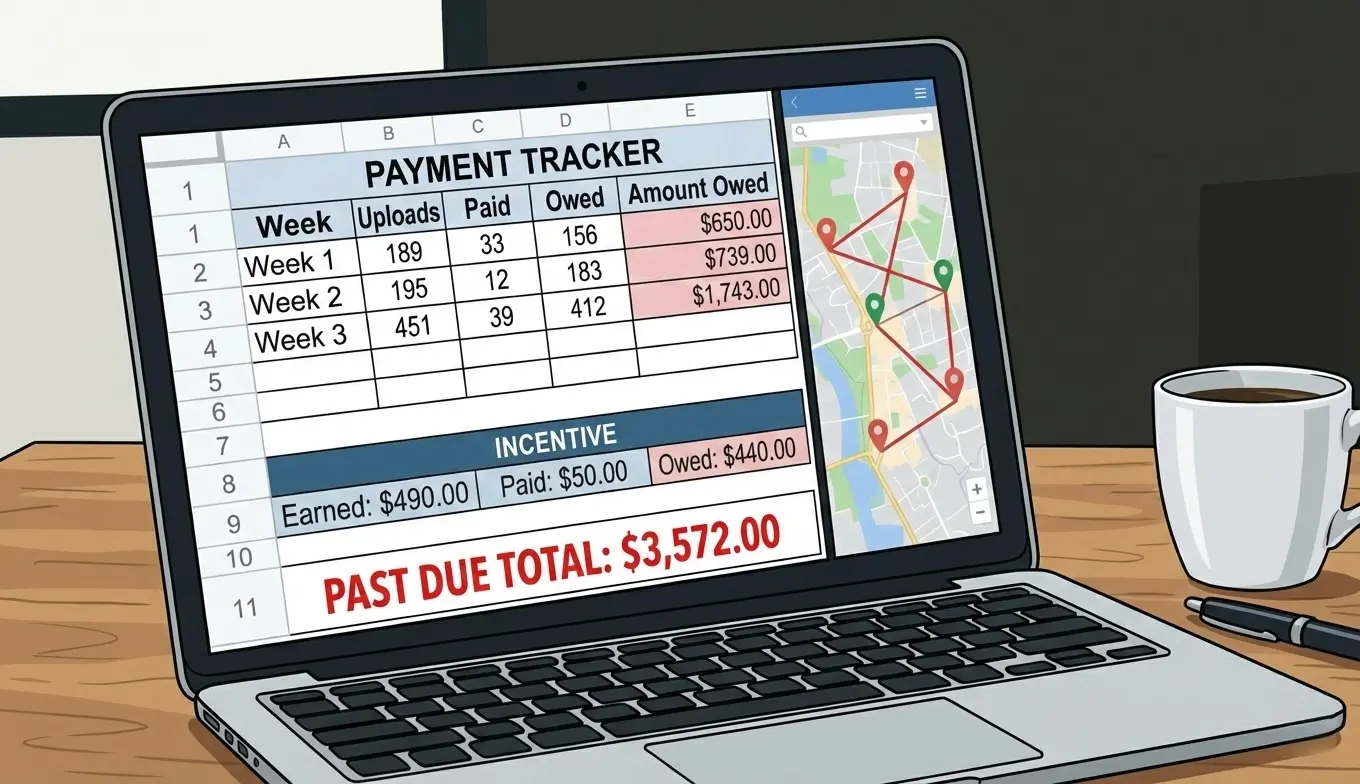
I’m a data analyst. I don’t operate on faith; I operate on facts. So, from day one, I tracked my own work. I didn’t just count uploads; I turned the project into a personal case study, running geospatial tracking and analytics on my own output. I wanted to see the efficiency patterns, but mostly, I have a simple rule: I am not going to trust someone else to count my money for me.
And it is a good thing I did.
Because as it turns out, the company couldn’t count. When the first numbers came back, they were wildly off—we were being credited for a fraction of what we had actually done.
At first, I played it cool. Small glitch, I thought. They’ll patch it by week two.
Week two came, bringing not a fix, but more problems. Then week three. By the start of week four, the project was paused entirely "until they figure it out." Now, an entire cohort of us are sitting in limbo, waiting on money we are owed, staring at a screen that says Paused while our bills stay very much Active.
But while waiting, I started looking at the macro picture. How does a failure like this affect a business in the long run?
I ran a quick sentiment analysis on the community discussions surrounding this project — the same kind of data that powers the Breaking Even platform heatmap — the same sentiment data we use to score each platform's current health. My algorithm almost immediately flagged the platform as a "scam." Not because it necessarily is one, but because the volume of "non-payment" reports spiked so violently that the data couldn't interpret it any other way.
Voices get loud very fast when it comes to money. Everyone starts screaming "Fire!" at once.
This is where the analyst in me fights with the optimist. Is this just a painful learning opportunity for a reputable company? Or are they facing actual solvency problems?
I’ll admit, my default setting has always been skepticism—but directed at the individual, not the institution. I’m the guy who looks for personal accountability first. If my daughter comes to me crying that she got hit, my first question has always been, "What did you do?" I assume there is a cause and effect, a reason for the friction.
But that mentality is hitting a wall.
I checked my logs. I verified my uploads. I have the geospatial data. I didn't do anything wrong. None of us did.
Am I naïve for thinking they’re still going to pay us? Maybe. But the data shows that once trust collapses, the "scam" label sticks, and that is a cost far more expensive than just cutting the checks.
For now, I’m still waiting. But next time, I’m not just tracking the work. I’m tracking the solvency.
Wondering what platforms are actually paying right now? See what every AI training platform actually pays — by task type, by skill tier, and what separates the $75/hr earners from everyone else. And if you want to understand why the money stops without warning, this one explains it: DataAnnotation & Outlier AI Work Drought: Why Tasks Disappear.
Everything we track on DataAnnotation: pay, reviews, and how to apply
Read Next
From the community
Join the conversation — no email needed →What workers are talking about
Comments
Leave a comment
Joshua Drake has worked on AI training platforms for over four years, tracking earnings, sentiment data, and platform stability across Outlier, DataAnnotation, Alignerr, and others. He has a degree in data analytics and runs this site, breakingeven.online and the sentiment analysis used to derive a sense of what is happening in a world often hiding in the shadows.