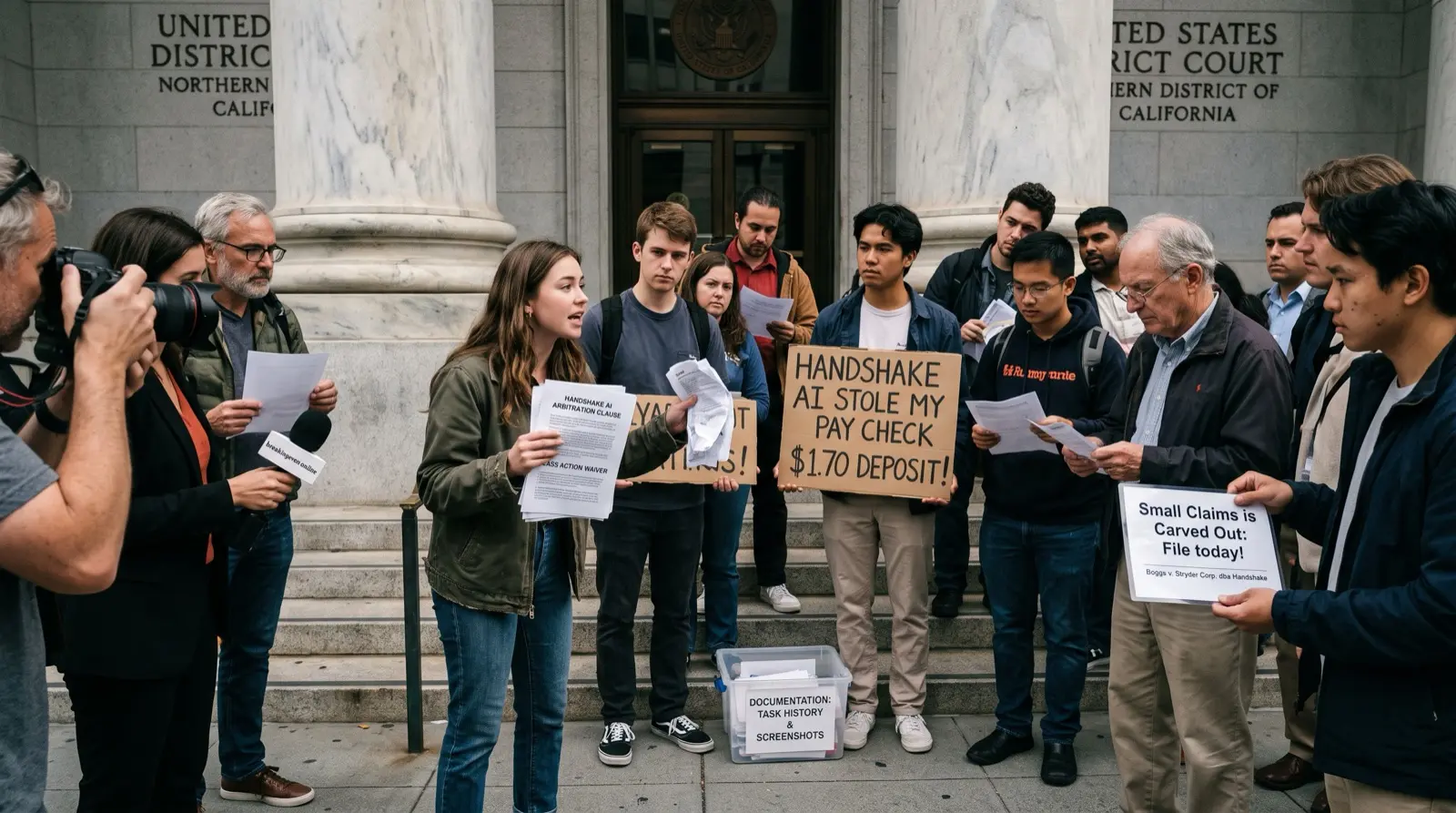
Handshake AI Lawsuit 2026: The Class Action, the August Pay Failure, and What to Document Today
Somebody posted their pay this week. Twenty hours of work, and a deposit of $1.70. Under it, a reviewer on a completely different project wrote that they were supposed to get $1,300 and got $50.
That was for this cycle. I'm not digging up news from March, and no, this isn't part of the Project HH mess that went down in May or part of all of those payment disputes that had to be filed in June. It's August, I stay current.
TL;DR: A proposed class and collective action, Boggs v. Stryder Corp. dba Handshake, was filed in the Northern District of California on July 20, 2026, case number 3:26-cv-07498. It alleges Handshake misclassified AI annotators as independent contractors. Separately, workers are reporting a payment failure right now, with deposits landing at a fraction of logged hours. Here is the part almost nobody has read: the Handshake AI terms of service contain a binding arbitration clause, a class action waiver, and a one year deadline to bring any claim. Small claims court is carved out of that clause. Screenshot everything today.
The filing happened, and this is what's actually on the docket
I saw that people were searching for this and got curious, and curiosity got the best of me. I ended up spending a little longer than expected going down that rabbit hole, but I did bring back the tea so let's drink up.
The case is Boggs v. Stryder Corp., filed July 20, 2026 in the United States District Court for the Northern District of California. The docket number is 3:26-cv-07498. Did you guys know Stryder Corp is the legal entity that does business as Handshake? I'm not sure why I didn't feel the need to investigate that, I was all over the Outlier and Scale relationship, but Stryder I have never heard of before, and it's the reason why digging for cases against "Handshake" in court databases got me nothing but deeper into the hole. The docket caption on two of the earliest filings reads "Boggs v. Stryder Corp. dba Handshake," and the case is styled with more than just Stryder as the defendant.
Law360 reported the filing as a proposed class and collective action alleging that a company recruiting workers to train AI models misclassified thousands of college students and others as independent contractors while controlling their assignments, their pay, and their work methods.
As of August 28, 2026, this is what the calendar has for the case:
| Date | Entry |
|---|---|
| July 20, 2026 | Complaint |
| July 20, 2026 | Proposed summons |
| July 20, 2026 | Certificate of interested entities and corporate disclosure |
| July 21, 2026 | Case assigned by intake |
| July 22, 2026 | Summons issued |
| July 22, 2026 | Initial case management scheduling order with ADR deadlines |
| August 5, 2026 | Summons returned executed |
| August 5, 2026 | Summons returned executed |
| August 10, 2026 | Clerk's notice regarding consent or declination |
| August 14, 2026 | Stipulation without proposed order |
| August 14, 2026 | Certificate of interested entities and corporate disclosure |
| August 20, 2026 | Pro hac vice application |
| August 21, 2026 | Order granting pro hac vice |
| August 25, 2026 | Consent or declination to proceed before a magistrate judge |
Two summonses came back executed on August 5, which lines up with more than one defendant. The defense submitted a second corporate disclosure August 14, out of state counsel filed to appear on August 20, and the court granted that appearance the next day. That reads like someone is spending some money to get some bodies on board. On August 25 a consent or declination to proceed before a magistrate judge hit the docket, which is routine early housekeeping, not a plot development.
What is not on that docket yet are any answers. There is no motion to dismiss and no motion to compel arbitration. The case is five weeks old, so nothing unprecedented, but it looks like it could be the beginning of a good telenovela.
The complaint itself is document number one, and it sits behind the federal court paywall. But I do love my stories, so I tried to buy it. This was not an easy process and at 2 am there was no one available to assist with fixing whatever issues the system had with my new account, so I have not purchased or read it...yet. As soon as I get my account squared away, I'll update the story accordingly. At this moment, all I've got is what is shown on CourtListener, which makes for a very dry teaser, and it lacks all of the sensationalism I can clearly see when I close my eyes. What it does give me is the court, the date, the case number, the caption, and the docket history, because those are public and I pulled them. I cannot give you the named plaintiff's full identity, the law firm carrying it, the specific counts, or the class definition, because those live inside a document I have not read, and I am not going to invent them so this article looks more complete than my sourcing is.
I dropped the link for the free portion below. If you do have a PACER account and you decide to read the docs, hook a guy up over here.
Just because you can't find the show doesn't mean you can't find some good old fashioned hearsay
Under Handshake's published schedule, payouts go to their partner pay platforms by Wednesday afternoon, covering Monday at 12:00 am PST through Sunday at 11:59 pm PST of the previous week, and can take 48 hours to appear. Their support page tells you to wait until Friday at noon PST before you contact anyone.
That is the design. Public posts across the last nine days describe something else:
- A worker posts 8 hours, 3 minutes and 33 seconds of completed task history that became 4 hours and 30 minutes of payable time on Project HH.
- A worker whose awaiting payout went to zero with no Stripe email, writing that they think they lost $1,570.
- A worker short $165 on Project G, the week after earning bonuses on the same project.
- A worker owed roughly $20 from two weeks earlier who is now short over $100, which they count as almost six hours worked for free.
- Two workers reporting that the payment tab itself vanished from the dashboard, so they can no longer see the hours they are trying to dispute.
- The reviewer from the top of this article: $1,300 expected, $50 received, on a project that is not HH.
That last one matters more than the dollar figure. Through the spring the pay failures were understood as a Project HH problem tied to the MM timer migration, which is the story I told in the payment schedule piece. Workers on other projects are talking about the same issues hitting them the same week. Whether that is one broken process or several separate ones, I can't tell you with confidence one way or the other. What I can say with confidence, after filling out five payment dispute forms in the last six weeks, is that it feels like more than just one thing. The pattern in the posts strongly suggests it is no longer contained to one project.
Worker reports from the project community channels line up with the public threads: bonus payments announced and then not paid out at the end of consecutive projects, pay disputes going a full week or more without a human reply, and pay term posts disappearing from the channels where they were originally posted.
I am not going to tell you Handshake stole this money. I do not know the mechanism, and neither does anyone posting screenshots. What I can tell you is that the volume and the spread of the reports this week are worse than anything I have logged on this platform, and that Handshake has declined to comment publicly on the wage allegations before.
The arbitration clause is the part nobody reads, and it decides everything
This is the section I would want someone to send me if I were owed $1,300 today.
The Handshake AI terms of service, as posted, say this:
You agreed to arbitrate. "You and Handshake AI agree to resolve any Disputes through final and binding arbitration." The American Arbitration Association administers it, in the county where you live or work, or San Francisco.
You waived class actions. The clause is titled "No Class Actions" and reads: "You may only resolve Disputes with Handshake AI on an individual basis, and may not bring a claim as a plaintiff or a class member in a class, consolidated, or representative action."
There was an opt out, and it was 30 days. You could decline arbitration by emailing [email protected] within 30 days of first accepting the terms, with your first and last name and a statement declining. If you onboarded months ago and did not send that email, that window closed.
You have one year. "Any claim or cause of action arising out of or related to your use of the Handshake AI products or Handshake AI Service must be filed within one (1) year after such claim or cause of action arose, or else that claim or cause of action will be barred forever." If you were shorted in March 2026, that clock runs out in March 2027.
There is a $100 liability cap on the company's total liability to you for damages under the terms, which is a common clause and one a wage claim would have to get around.
Read together, those terms are built to keep you out of the Boggs class and into a room by yourself. That does not mean the class action is dead. Handshake has to actually ask the court to enforce that clause, and as of today no motion to compel arbitration appears on the docket. Courts also decline to enforce these clauses more often than the clauses suggest, and misclassification claims brought under California's representative statutes have survived class waivers before. I am telling you what the contract says, not predicting what a judge does with it.
Here is the door the contract leaves open on purpose.
Small claims court is carved out, and that is the fastest money
Buried in the same arbitration section is an exception. Either side "may assert claims, if they qualify, in small claims court in San Francisco, California, or any United States county where you live or work" up to that court's limit for individuals.
You do not need a lawyer. You do not need to wait for a class to be certified. Filing fees in most states run somewhere between $30 and $100, and small claims limits are $10,000 to $12,500 in a lot of states, well above what most workers are owed here.
One caveat. Handshake also publishes a separate contractor agreement with its own arbitration section, and that version does not repeat the small claims line. Which document controls your dispute is a lawyer question I cannot answer for you. What the public record shows is that workers have already taken Handshake to small claims court anyway, and one of them won.
This is not theoretical. Business Insider reported in March that one contractor filed for $9,600 and dismissed the case in mid January, and that a separate contractor who was accused of using AI on their tasks brought an unpaid wages case that a court resolved in October with a ruling that the contractor be paid $6,475.
One person. One filing. Money.
| Route | What it costs you | Realistic timeline | What has come back so far |
|---|---|---|---|
| Handshake pay dispute form | Free | Days to two billing cycles, sometimes no reply at all | Workers report disputes eventually paid out, sometimes after a long backlog |
| Small claims in your county | Filing fee, usually $30 to $100 | Two to six months | A court ordered $6,475 paid to one contractor |
| Individual AAA arbitration | Handshake pays AAA fees for claims under $75,000 | Six to eighteen months | No public outcomes yet |
| The class action | Nothing up front | See below | Nothing yet, the case is five weeks old |
What a class action realistically means for your money
I want to lower the temperature on this, because "class action" reads to a lot of people as "the money is coming."
Look at the closest comparison in this industry. McKinney v. Scale AI, a misclassification case brought on behalf of California data labelers in San Francisco Superior Court, was filed in December 2024. It reached a $12,500,000 gross settlement, roughly $7,543,333 after deductions, and the final approval hearing is scheduled for October 30, 2026. That is close to two years from filing to a hearing that has not happened yet, and payments come after that.
Boggs was filed a month ago.
So the realistic picture for someone owed $1,300 today: if this case survives a motion to compel arbitration, then survives a motion to dismiss, then gets a class certified, then settles, you might see a check in 2028, and the amount will be calculated on your workweeks in the class period rather than on the specific hours you are missing. It could be a few hundred dollars. In the Scale AI settlement, eligible workers get paid automatically with no claim form, which is the good version of this outcome.
The class action is worth watching. It is not a plan for August rent.
What to save today, before you lose access to it
Every worker in the threads who got money back had documents. Every worker who did not, did not. The single most common regret in those posts is some version of "I should have taken more screenshots."
Do this today, not after you get deactivated. Accounts in these reports go under review while people are mid task, and the payment tab has disappeared for some of them.
- Task history with timestamps. Screenshot or export every task with its logged time, before you submit it, not after. Get the task IDs. The worker who documented a discrepancy down to task IDs and time measurements is the one who had a case.
- The payment dashboard, twice a week. Awaiting payout and pending on Tuesday night, before the Wednesday payout run, and the paid screen again Friday afternoon after the deposit window closes. Balances in these reports have reset to zero, and for some workers the payment tab itself disappeared.
- Your rate and your project terms. Handshake's own support page says some projects run a different payment schedule and that it will be specified in your Project Terms. Save that document. It is the thing that proves what you were promised.
- Bonus and incentive announcements. Save the Slack posts and emails announcing bonus tiers. Workers report those posts being deleted from the channels afterward. A screenshot of a deleted policy is worth more than one of a policy still up.
- Every support ticket and every reply. Full email threads with dates, including the template responses. Use the support channel rather than Slack so there is a ticket number.
- Your Stripe records. Deposit amounts and dates, plus any failed payment notices.
- Your 1099 and your W-9 or W-8. These establish the relationship and the reported totals. Do not wait until January.
- A one page running log. Date, hours worked, rate, expected, received, difference. Small claims filings and dispute forms both come down to that table.
Then file the pay dispute form. Handshake's support page says to wait until noon PST on Friday before reaching out about missing pay. Workers who got paid describe filing the dispute with a written breakdown of what is owed and why, and having it paid out, sometimes after a long backlog. One worker on the August threads put it simply: they had submitted multiple payment disputes and every one was eventually paid.
Where this leaves you
Handshake is the highest paying platform I track, and I have said that plainly for a year and a half. I earned $4,800 there in 2026, and $4,500 of that came in January. I have also filled out four payment dispute forms on one issue because the person handling it had not read what I sent six weeks earlier. Both of those things are true about the same company.
If you are owed money right now, the class action is not your remedy and the arbitration clause is the reason. Your remedies are the dispute form this week, and small claims in your own county after that, and the one year clock is already running on the oldest of it.
File the dispute, screenshot everything, and count the class action as a bonus that arrives in a couple of years or not at all.
Docket details pulled from the public CourtListener record for Boggs v. Stryder Corp., 3:26-cv-07498, current to August 28, 2026. The complaint itself is paywalled on PACER and I have not read it, so no description here of the counts, the class definition, or plaintiff's counsel. Contract language is quoted from the Handshake AI terms of service as posted at the time of writing. Worker reports are drawn from public Reddit threads dated August 12 to August 20, 2026, and from aggregate patterns in project community channels with no individual identified. Nothing here is legal advice.
Everything we track on Handshake AI: pay, reviews, and how to apply
Read Next
From the community
Join the conversation — no email needed →What workers are talking about
Comments
Leave a comment
Joshua Drake has worked on AI training platforms for over four years, tracking earnings, sentiment data, and platform stability across Outlier, DataAnnotation, Alignerr, and others. He has a degree in data analytics and runs this site, breakingeven.online and the sentiment analysis used to derive a sense of what is happening in a world often hiding in the shadows.