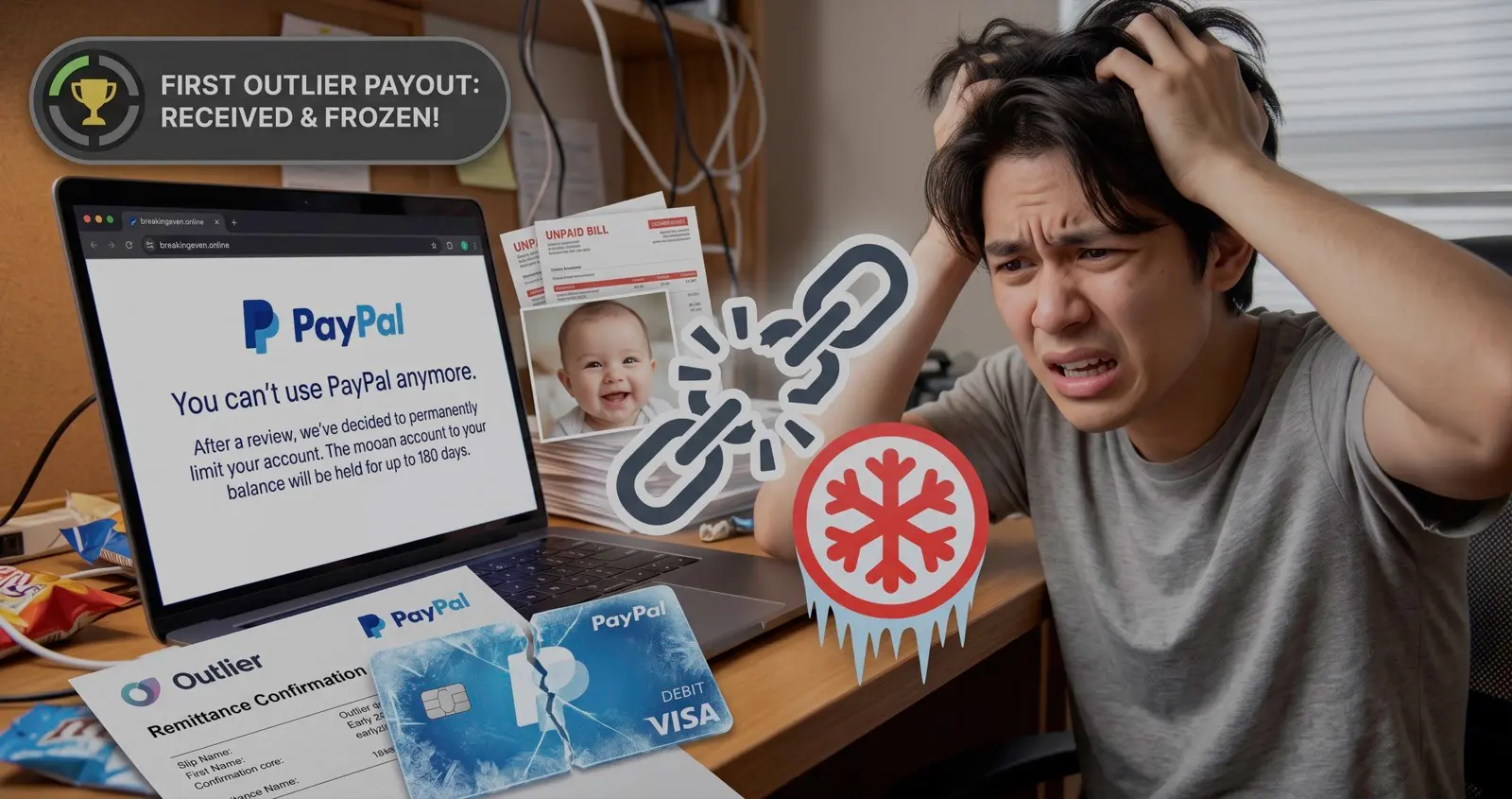
Your First Outlier Payout Hit PayPal — and PayPal Froze It. Here's Why, and How to Not Be Next
TL;DR: A recurring worker report: the first Outlier payout arrives and PayPal declines it, limits the account, or freezes the balance — sometimes for months. The trigger is usually PayPal's risk system, not Outlier: fresh business income hitting a dormant, mismatched, or previously flagged personal account. Protect yourself before payday: use a clean, fully verified PayPal account whose name, address, and tax details exactly match your Outlier profile; log in and use the account before the first payout; respond to any verification request immediately with exactly what's asked. If your PayPal history is rocky, look at the PayPal prepaid card as a possible alternate path or use Airtm where offered. And treat pending platform earnings as at-risk money until they're in your bank.
The message arrives on the exact day it can do the most damage: "PayPal declined your recent payment."
One worker in Tanzania got it on the morning of their first-ever Outlier payout: "I was expecting to receive my first payment in my PayPal account today, but unfortunately I received a message that PayPal declined this payment... This has made my day worse." A worker in India posted the same story the same month — payment day, dashboard shows paid, PayPal shows failed. Another had already moved past asking why: "PayPal suspends accounts and doesn't release the money. Don't use them."
If you read our coverage of Outlier's withheld payouts, you know one version of losing your money — the platform end. This is the other version, and it's crueler in a way, because the platform actually paid. The money left Outlier. It just never became yours, because the payment processor in the middle looked at your account and said no.
Here's what's actually happening, what workers did to get unstuck, and — the part that matters most — how to set yourself up so it never happens to you.
Why first payouts trigger freezes
PayPal's risk system doesn't know you're a legitimate worker who just finished a brutal onboarding and a week of tasking. It knows patterns. And the pattern of a first Outlier payout is, from a risk engine's chair, indistinguishable from the pattern of fraud:
- A dormant or brand-new account suddenly receives money. Most people's personal PayPal has been sitting idle since they split a dinner bill in 2023. Then a company payment lands.
- The income is from a source the account has never seen, often cross-border, often at an amount larger than anything in the account's history.
- Details don't quite match. The name on the Outlier profile says one thing, the PayPal account another. The address is old. The tax info points somewhere else. One worker's payment failed for the simplest version of this: a typo'd PayPal email in their Outlier settings.
- Geography. Workers in some regions report PayPal has simply pulled back: "PayPal has locked most Africans in East Africa out of its service since start of June." No individual fix exists for that one — that's a rail being switched off.
Any of these can produce a decline. A decline plus a risk flag produces a limitation — the account state where PayPal asks for identity documents before releasing anything. And a limitation that goes badly becomes the outcome every thread warns about: a permanent limitation, with the balance held for up to 180 days. That's PayPal's standard practice for accounts it closes, and it means your first month of Outlier earnings can spend half a year in administrative limbo while being, technically, "yours."
None of this is in Outlier's system, they've paid and they are done. Which is exactly why Outlier support can't fix it — so don't waste your time opening tickets with them, they can't help.
What actually got workers unstuck
The threads contain both speedruns and horror stories, and the difference between them is consistent.
The speedrun: a worker in India got the verification request, treated it as the whole battle, and won it in a day — "They asked for verification. I provided details and was back active in 1 day. They are just trying to match the details to that of ID." Note what that worker did: gave PayPal exactly what it asked for, immediately, and fixed the mismatch (in their case, updating the address in PayPal to match the ID).
The pattern in every fast resolution:
- Respond to the verification request itself. Not a new support ticket, not a complaint thread — the specific document upload PayPal's limitation notice asks for.
- Make everything match. The name, address, and identity documents you give PayPal should agree with each other and with your Outlier tax profile. Mismatch is the thing being investigated; alignment ends the investigation.
- Confirm your Outlier payment settings while you wait. The declined payment usually retries or reissues — one worker asked when, and the answer from the community was that failed payments come around again on the next cycle. Make sure the email it retries to is correct and verified.
- If PayPal restores you, the money flows. If PayPal permanently limits you, stop waiting on the appeal and switch your Outlier payment method — the 180-day clock on the held balance runs regardless, and your future earnings need somewhere to land now.
The part nobody does: set up the payment path before payday
Every stuck worker in those threads would trade anything to redo one week — the week before their first payout.
Use a clean PayPal account. Clean means: fully verified (ID confirmed, bank or card linked, email confirmed), in your legal name matching your Outlier profile exactly, with a current address, and ideally with some normal activity — log in, send a friend $5, keep it warm. A verified account with history absorbs a new income source far better than a cold one. If your account is old, log in before payday and confirm nothing is stale.
If PayPal and you have a past — don't bring it to payday. If you've had an account limited, a dispute gone bad, or a balance held before, that history is attached to your identity, and routing new gig income at the same flagged identity is asking for a rerun. Two options worth checking.
I had some eBay problems going way back and yes, they held my money for six months before I got it back and I swore never to use them again. Well, that wasn't an option here. So I opened a new account, new email address and phone number. Made payments through the account, linked my bank, and haven't had a problem. But if you don't plan ahead for all the problems that find a way to us, you are gonna have a rough time.
-
The PayPal prepaid Mastercard. It's a separate prepaid product in the PayPal family that can receive transfers, and for someone whose main PayPal history is rocky, it may offer a working path that a standard account won't. I'm flagging it as an option to investigate rather than a guarantee — prepaid products carry their own fees and terms, and PayPal's rules on linking them change. Read the current terms before you rely on it for payroll-sized money. I've used this too, and in a pinch it worked.
-
Skip PayPal where you can. Outlier offers Airtm in many regions, and workers hit by PayPal freezes have migrated: "So I chose Airtm as my new payment method." The India threads debate the tradeoffs honestly — Airtm's exchange rate can beat PayPal's, but local withdrawal (peer-to-peer versus on-ramp) has its own risks and fees. There's no universal winner; there's the rail that works in your country. Pick it deliberately.
PayPal is another shady company, and maybe like Outlier and these other platforms they need to be to combat fraud, but I don't care for shady when it comes to my money. So hear me when I say just like Outlier is not an employer, PayPal is not a bank. You have none of the protections that a bank offers you by law. They can hold your money and never give it back if they choose to, so when you do get paid, do not let it sit in PayPal for use later, because you have no guarantees with this company because...and I'll just say it this one last time... They are NOT a bank.
Whichever rail you choose, verify it completely before the first payout. A payment method switch mid-cycle is its own delay — workers asking "if I change my payment method, will my pending earnings follow?" get a shrug and a wait.
Your money is at risk until it's in your bank, or in your hand. That's the same advice I gave in the ban-wave coverage, and it applies on the processor side too. Money on the dashboard is a promise. Money in PayPal is a promise from a different company. Money in your bank or your hand is yours. Move it down that chain as fast as you can, every time.
The bigger lesson
The worker in Morocco who told the subreddit that $7.50 an hour "is like a dream to me" was using the money for his daughter's medical bills. When your platform income is that kind of load-bearing, the payment rail is not a detail — it's the last mile of your paycheck, run by a company you don't work for, with a risk engine that has never heard of you.
You can't control Outlier's payout timing and you can't control PayPal's risk model. You can control whether the account catching your money is verified, matched, warm, and clean. Do it now so you are not waiting for half a year.
Had a freeze play out differently than what's described here — or found a payment path that works better in your country? Tell me and I'll add it. This is the kind of article that gets more useful with every worker who corrects it.
Frequently Asked Questions
Why did PayPal decline or freeze my first Outlier payment?
Because a sudden business payment landing in a personal account with little history looks, to PayPal's risk system, like exactly the pattern fraud looks like. Dormant account, new income source, sometimes a country PayPal treats as higher risk — any of those can trigger an automatic decline or an account limitation pending identity verification. Workers report the same sequence over and over: dashboard says paid, PayPal says no. It has nothing to do with your standing at Outlier.
How do I get a limited or frozen PayPal account released?
Respond to the verification request instead of opening new tickets. Workers who cleared it fastest submitted exactly what PayPal asked for — government ID, address confirmation, sometimes proof of the income source — and made sure the details matched their Outlier tax info. One worker in India reported being fully restored in a day after providing ID and matching their address. Slow-rolling the verification or arguing with support first is what turns days into months.
Can PayPal hold my money for 180 days?
Yes. When PayPal permanently limits an account, its standard practice is holding the balance for up to 180 days before making it available. That's the worst case, and it's the one workers warn each other about: "PayPal suspends accounts and doesn't release the money." It's why the setup you use before your first payout matters more than anything you can do after a freeze.
What if I've had PayPal problems in the past?
Don't route new gig income into an account PayPal has already flagged once — history follows the account and the identity attached to it. Options worth checking: the PayPal prepaid Mastercard, which is a separate product that can receive transfers and may give someone with a rocky PayPal history a working path; or skipping PayPal entirely where Outlier offers Airtm in your region. Verify current terms yourself before payday — products and fees change.
Is Airtm better than PayPal for Outlier payments?
It depends on your country. Workers in India debate it both ways: Airtm's exchange rate can look better, but moving money from Airtm to a local bank has its own risks and fees depending on whether you use peer-to-peer or on-ramp withdrawal. Workers in regions where PayPal has pulled back — several East African countries have reported being locked out since June — often don't have the choice. The consistent advice from the threads: whichever rail you pick, verify it fully before your first payout lands, not after.
Everything we track on Outlier: pay, reviews, and how to apply
Read Next
From the community
Join the conversation — no email needed →What workers are talking about
Comments
Leave a comment
Joshua Drake has worked on AI training platforms for over four years, tracking earnings, sentiment data, and platform stability across Outlier, DataAnnotation, Alignerr, and others. He has a degree in data analytics and runs this site, breakingeven.online and the sentiment analysis used to derive a sense of what is happening in a world often hiding in the shadows.