Outlier AI Is Not the Same Platform It Was. Here's What Happened.
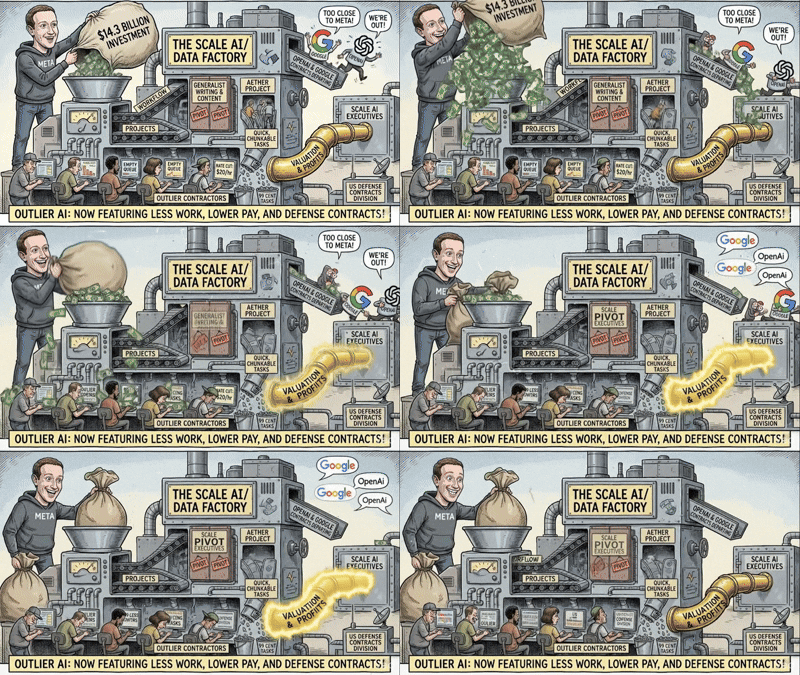
TL;DR: Meta's $14.3 billion investment in Scale AI (Outlier's parent company) caused OpenAI and Google to pull their data contracts — they couldn't trust a vendor tied to their biggest rival. Scale AI then laid off 200 employees and 500 contractors. Outlier pay dropped from ~$50/hr to ~$20/hr for many workers. Two government investigations followed. The money went to defense contracts and executive valuations, not to worker conditions.
When the news broke that Meta was investing $14.3 billion into Scale AI, I thought, holly ****, this is goinig to be a well paid and busy year.
If you were working on Outlier at the time, you probably had one of two reactions.
Either you didn't see the news at all — because why would you, you're a contractor, nobody sends you a memo about anything.
Or you saw it, and somewhere in the back of your mind, a small part of you thought: maybe this means more work.
Fourteen billion dollars is real money. It's "we are very serious" money. That's the kind of dollars that funds new projects, has new clients, and creates new well paid opportunities. Right?
I'm going to walk you through what went down after that deal was announced, because the story of Outlier in 2025 and 2026 is not the story most people think it is. And if you're still working on Outlier — or you used to — you should at the very minimum, be allowed to understand exactly what changed and why.
First: What Scale AI Actually Is
Before we get into what happened, we'll make sure everyone is on the same page. It's not common knowledge, what the relationship between Scale AI and Outlier is.
Scale AI is the company. Outlier is the product.
Scale AI is a tech company worth billions of dollars. Their business is selling AI training data to the biggest AI labs in the world — companies like OpenAI, Google, and Meta. They collect human feedback, label data, and package it into training sets that help improve models.
Outlier is how they get that human feedback. It's the platform where you — the contractor — do the actual work. You write prompts. You rate AI responses. You debug code. You spend your brain power improving someone else's model.
You are the raw material.
Scale AI's clients pay Scale AI. Scale AI pays you — but only the part they can't automate or offshore yet. The whole setup is designed to extract as much value as possible from human labor, at the lowest sustainable price, until they don't need that human labor anymore.
No feelings involved or implied with that summary, just the facts. That is what the business model is. And once you fully understand that, everything that happened next makes perfect sense.
The Deal That Changed Everything
In the summer of 2025, Meta — the company behind Facebook and Instagram — invested $14.3 billion into Scale AI.
That number was all over the tech news. It was one of the biggest AI deals in history. Scale AI's CEO appeared in interviews looking very happy. Investors celebrated.
You were probably doing tasks on Outlier.
Here is what that deal actually meant for the people doing the work:
Meta is a competitor to OpenAI and Google. When Meta poured that kind of money into Scale AI, OpenAI and Google both made the same decision: they couldn't keep sending their AI training contracts to a company that was now deeply tied to their biggest rival. It was too much of a risk. Their secrets — their model architectures, their training approaches — were now flowing through a company in which Meta had a massive financial stake.
So they left.
OpenAI pulled its data contracts from Scale AI.
Google pulled its data contracts from Scale AI.
You never got a notification about this. Nobody sent you an email. The projects just started drying up, and you thought maybe it was the Empty Queue thing again, or maybe your quality score, or maybe the batch just ended.
It wasn't any of those things. The clients left. And when the clients leave, the work leaves with them.
What Scale Did Next
A company that just lost two of its biggest clients still has a valuation to protect and investors to answer to. So Scale AI did what companies do when the revenue picture changes: they cut.
In July 2025, Scale AI laid off 200 full-time employees. That's 14% of their staff, gone in one sweep. They also terminated 500 contractors — sent via email, no warning, effective immediately.
Some of those contractors were then invited to join Outlier as gig workers.
Read that again. The same company that just fired them, told them to sign up for the platform with no hourly guarantee, no benefits, no protection. But hey, there might be tasks available.
That is the Mercenary Pivot being done to them, not by them.
And here's what that meant for you, if you were already on Outlier: more competition for the same shrinking pool of tasks. The laid-off contractors didn't disappear. They joined your queue.
The Pay Cuts They Didn't Announce
In October 2025, Scale shut down its generalist contractor team in Dallas entirely. The team that handled writing, content, and general language tasks — gone. The official reason was a "pivot toward more technical, expert-level work."
What that actually meant: the lower-skill, lower-margin work was being cut or moved somewhere cheaper.
By December 2025, a major news outlet ran an investigation based on contractor accounts. What they found:
- Many contributors reported rate compression from ~$40–$50/hr project rates to ~$15–$20/hr baseline work (per r/outlier_ai community reports)
- Workers were spending 40 hours in unpaid onboarding on new projects without landing a single paid task
None of this was announced. None of this was communicated. The rate just changed. The project just got smaller. The queue just got quieter.
And you sat there refreshing your dashboard wondering what you did wrong.
You didn't do anything wrong. The floor dropped out from under you, and nobody told you.
The Government Investigation You Probably Never Heard About
In March 2025, the U.S. Department of Labor opened an investigation into Scale AI. The allegation: potential wage violations and misclassification of contractors.
Misclassification is a legal term that means treating workers like independent contractors when the law says they should be employees — with the protections and benefits that come with that status.
The DOL investigation was dropped in May 2025, with no public explanation.
But then San Francisco's own Office of Labor Standards Enforcement opened a separate probe in September 2025.
Two government investigations. In one year. Into one company.
Again — you probably did not hear about any of this. You're a contractor. You're Worker ID 1fbabed33c28. The system does not send newsletters to its components.
Where All That Money Actually Went
Here's the part that I think about the most.
After the Meta deal, Scale AI's valuation shot up. They were worth more money, on paper, than almost any AI company that isn't OpenAI. The people at the top got wealthier. The investors celebrated.
And Scale AI started winning defense and government contracts — reportedly up to $199 million in defense-related work since the Meta deal. They are now training AI for the U.S. military and government agencies.
I have many strong feelings about the ethics behind this and some of these platforms on the whole that will remain private, but I will share this. AI gig work was not supposed to be a replacement for a day job. It was supposed to be extra. But if you could make it work at $50 and still have some level of instability, power to you because at $50 you are bringing home about the same as you would if you were working a full time job with healthcare, 401K and a human resources department. But the jobs really don't pay $50/hr for the most part and the bell curve only gets bigger and bigger the lower the pay gets. At a certain point it feels predatory.
The $14.3 billion didn't improve your working conditions. It changed who your work was for.
The bottom line is that the people at the top got richer, the investors got richer, and the workers who didn't fully understand the rules got poorer. Don't forget the rules. Treat this like it's extra so that it always is. This is not a career, it's a hustle.
The Chatroom That Went Quiet
One of the most honest data points I've seen in all of this isn't in a news article. It's in the numbers from Outlier's own contributor communities.
Workers who track these things reported that activity in Outlier's main chatrooms — the places where thousands of contractors used to coordinate, share tips, and ask questions — plummeted after the Meta deal. Weekly threads that used to pull hundreds of replies were pulling dozens.
The workers didn't all quit. They didn't all get banned. The conversations just... stopped. Because there was less to talk about. Less work. Less hope. Less reason to show up.
That silence is the most honest metric I know of. People don't stop talking about their work when things are good.
What Aether Looks Like Now
The Aether project — Outlier's flagship coding work — is still running. But it's different.
The way Outlier describes it now: "quick, chunkable, low-lift tasks."
Quick. Chunkable. Low-lift.
Those are not the words you use to describe something you're paying $45/hr for. Those are the words you use to describe something you've broken into smaller pieces that require less skill and can be paid less.
Workers are getting removed from Aether after two or three weeks with no explanation. The people who won the $20,000 grand prize contest Outlier ran around the project — that's real, that happened — but a grand prize contest is also something you run when you need to keep people engaged on a project that isn't holding them on its own.
Aether still pays better than a lot of alternatives. That remains true. But it's not what it was in 2024. And if you're building your budget around what Aether was, you're going to get hurt by what Aether is.
I'm Not Telling You to Quit
I want to be clear about something before we get to the end of this.
I am still on Outlier. I still check the queue. I still work the Aether tasks when they're there, and I still take the $20/hr work when that's all that's available. Because $20 is better than $0, and I am under no illusion that any of these platforms owe me anything more than what they owe me right now.
What I'm telling you is this:
The platform you signed up for and the platform you're on today are not the same platform.
The Outlier of 2023 and early 2024 was a rising platform with serious clients, competitive rates, and real growth. The Outlier of 2026 is a leaner, more technical, lower-volume operation that is pivoting its parent company away from the kind of work that made you money.
You're not imagining the change. The change is real. It's documented. It's the result of decisions made in boardrooms by people who never thought about you once while they were making them.
What You Do With This
The same thing you always do when a platform changes.
You don't quit in anger. You don't write a long post about how you've been betrayed. You don't wait around hoping it goes back to what it was.
You look at the full landscape. You apply to the platforms you haven't tried yet. You work Outlier for what it is right now, not for what it used to be.
DataAnnotation is still running. Alignerr has six active projects right now. Telus AI just added 6,100 contractors to its global workforce. Mercor is in legal trouble but was paying $1.5 million a day to contractors before that — that infrastructure doesn't disappear overnight.
The work exists. It just doesn't live in one place anymore.
Work it like it ends tomorrow. It usually does.
And when it does — wherever it does — you already know what comes next.
You find the next faucet, or if you remembered the rules who knows, you might already have your pool full.
If you're an Outlier worker dealing with a sudden empty queue or account removal, here's exactly what's happening and what to do about it. For a full breakdown of which platforms are active and paying right now, see the 2026 Tier List. And if you want to understand how we got here — the full psychological and economic trap that this space runs on — this is the piece that explains it.
Everything we track on Outlier: pay, reviews, and how to apply
Read Next
From the community
Join the conversation — no email needed →What workers are talking about
Comments
Leave a comment
Joshua Drake has worked on AI training platforms for over four years, tracking earnings, sentiment data, and platform stability across Outlier, DataAnnotation, Alignerr, and others. He has a degree in data analytics and runs this site, breakingeven.online and the sentiment analysis used to derive a sense of what is happening in a world often hiding in the shadows.