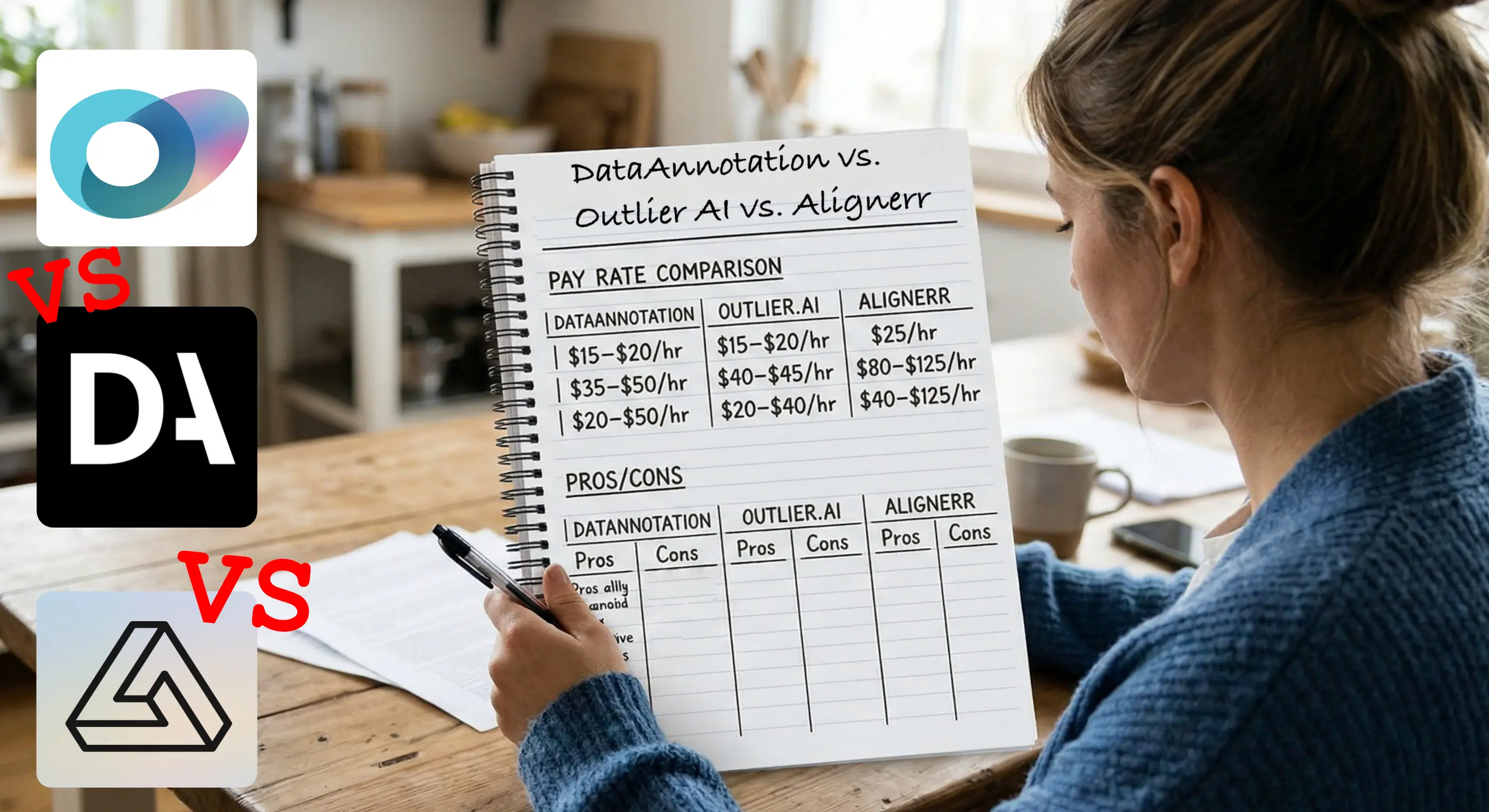
Outlier AI vs DataAnnotation vs Alignerr: Which Pays More in 2026?
The question gets asked in every subreddit, every Discord, every forum thread where AI gig workers congregate. It comes in different forms depending on where someone is in their journey:
Is DataAnnotation still paying $40/hr like Outlier claims?
I'm on the Alignerr waitlist — is it worth waiting or should I just go back to Outlier?
Which one should I do first?
The honest answer is that all three platforms can pay well, none of them will tell you the full truth about what you'll actually earn, and which one is "better" depends almost entirely on what you bring to the table. So let's break it down by what actually matters: pay floor, pay ceiling, stability, and who each platform is really designed for.
Bottom line though, no single one should be your only source of income. So yes, you should apply for Alignerr, and you should apply for DataAnnotation, and you should apply for Outlier. Because the truth is, you never know which one is going to have work available, and you can never be certain you won't wake up one morning and have your account removed with no explanation.
The Pay Comparison, Straight
| Outlier AI | DataAnnotation | Alignerr | |
|---|---|---|---|
| Typical floor | $15–$20/hr | $15–$20/hr | $25/hr |
| Typical ceiling | $35–$50/hr | $40–$45/hr | $80–$125/hr |
| Advertised rate | $20–$50/hr | $20–$40/hr | $40–$125/hr |
| Who hits the ceiling | Bilingual, STEM, coding | Coding / STEM specialists | Credentialed specialists |
| Pay schedule | Weekly (PayPal / Payoneer / ACH) | Weekly (PayPal only, Mondays) | Weekly (PayPal, Wed–Fri) |
| New worker realistic rate | $15–$22/hr | $15–$25/hr | $25–$40/hr (if matched) |
The platforms' advertised ranges are real. They are also the result of averaging together workers at radically different skill tiers. The $40/hr DataAnnotation worker and the $17/hr DataAnnotation worker are both telling the truth about their experience. They are just not the same person.
Outlier AI: High Volume, High Variance
Outlier is the platform most people encounter first, and for good reason — it has the largest task volume in the space and the lowest barrier to entry for English-language work. If you can write clearly and reason through a prompt, you can get started.
The pay reflects that accessibility. General English tasks land most workers between $15 and $22/hr. Coding tasks, bilingual work, and specialized STEM projects push into the $30–$50 range. The ceiling is real but it's not automatic — Outlier's algorithm assigns you to projects based on qualification scores, and you don't negotiate your rate.
The bigger problem with Outlier in 2026 is volatility. The platform has moved aggressively toward "just-in-time" project allocation, which means even highly-rated contributors see frequent dry spells between projects. You can earn well for three weeks and then face two weeks of nothing. If you need consistent monthly income, that instability is a real cost that doesn't show up in the hourly rate.
Outlier is for you if: You want volume, you can tolerate feast-or-famine cycles, or you're building up your skills while earning. It's the best platform for high task variety and the worst for predictable income.
DataAnnotation: The $40/hr Question
DataAnnotation's $40/hr number is the most frequently debated figure in AI gig work. The short answer is: yes, it's real. The longer answer is more complicated.
DataAnnotation's pay structure is task-type dependent more than platform-wide. General annotation and evaluation tasks for non-technical workers cluster around $15–$20/hr. Code-focused tasks — debugging, code review, software development evaluation — regularly pay $30–$45/hr. That's where the $40/hr figure comes from, and it's accurate for that slice of the work.
What DataAnnotation does better than Outlier in 2026 is queue stability. Workers report more consistent task availability and fewer silent dry spells. The tradeoff is that DataAnnotation's onboarding is a black box — there's no AI interviewer, no score feedback, no clear signal about why you did or didn't get matched to a project. You apply, you complete the assessment, you either get tasks or you don't.
DataAnnotation is for you if: You have a coding or technical background and want consistent access to $30–$40/hr work without Outlier's volatility. It's also a solid parallel option — most workers who use both find that when one queue is empty the other often isn't.
Alignerr: The High Ceiling Nobody Talks About
Alignerr is where the conversation usually breaks down, because people either haven't heard of it or they tried to apply and got stuck on the waitlist. Both reactions are understandable, and both miss the point. I cover the whole platform in the Alignerr review 2026 if you want the deep dive, including the WorldSim eval and the silent account deletions.
Alignerr is not competing with Outlier and DataAnnotation for the general AI gig worker. It's competing for credentialed specialists — doctors, lawyers, senior engineers, PhDs — and paying them accordingly. The $40–$80/hr range is real for qualified general technical workers. The $100–$125/hr range is real for medical and legal specialists. Those numbers exist because the clients are paying for expertise that's genuinely hard to find.
The catch, and it's a meaningful one, is the waitlist. Alignerr matches workers to specific client projects, which means you can pass the Zara AI interview, complete the onboarding, and then wait weeks or months for a project that fits your expertise to become available. The platform matches you up randomly, so you may not get a project for some time. Yet another reason you should have them all in your toolbelt.
The Zara interview itself is worth mentioning: it's a 15-minute AI-conducted conversation that focuses specifically on your domain expertise and reasoning depth. It's more rigorous than anything the other platforms do. There were disccussions about phasing out Zara for multiple reasons, but I am not sure if that has been made official or is still working itself out.
Alignerr is for you if: You have a verifiable credential or deep domain expertise and you can afford to wait for project matches. Treat it as the high-ceiling platform in a diversified stack, not a standalone income source.
The Stack Answer
The workers consistently earning the most from AI gig work in 2026 are not monogamous to a single platform. They run a stack:
- Outlier or DataAnnotation for consistent task availability and baseline income
- Alignerr as the high-ceiling option when a project match comes through
- Babel Audio as the fallback when both queues go quiet
The comparison question — which pays more — is a little like asking whether a salary or a bonus pays more. They're different instruments for different purposes. Outlier and DataAnnotation are your salary. Alignerr is your bonus. The goal is to have both running, because none of them offer the security of a regular job with a human resource department.
What The Data Actually Shows
Our sentiment tracking across thousands of worker posts tells a consistent story:
- Outlier generates the most conversation — and the most complaints. Volume and volatility go together.
- DataAnnotation scores higher on reliability and pay satisfaction among workers who stuck around past the first month.
- Alignerr has the fewest posts but the highest positive sentiment among workers who are actively placed on projects — because the workers who are frustrated simply left.
And I have to say, I concur with the data here, 100%
If you're starting from zero today and choosing one: start with DataAnnotation if you have any technical background, start with Outlier if you don't. Apply to Alignerr immediately regardless — the waitlist starts the clock, and your future self will thank you for not waiting.
Want the full breakdown of what every AI training platform pays — not just these three? We ran the numbers across the entire market.
Frequently Asked Questions
Which pays the most: Outlier, DataAnnotation, or Alignerr?
Alignerr has the highest ceiling at $25–$125/hr, but those top rates require credentials and surviving a long waitlist. Outlier runs $15–$50/hr with high volume and high variance, and DataAnnotation runs $15–$45/hr — the most stable of the three, and the best for coders at $30–$45/hr. For most workers the highest realistic everyday pay comes from DataAnnotation's coding tasks; Alignerr's $125/hr is real but rare.
Which of the three platforms should I start with?
Start with DataAnnotation if you have any technical background, and Outlier if you don't. Apply to Alignerr immediately regardless — the waitlist starts the clock, so the sooner you apply, the sooner you're eligible for placement.
Should I rely on just one of these platforms?
No. No single platform should be your only income source. Outlier's volume is volatile, DataAnnotation's queues ebb and flow, and Alignerr's placements are sporadic — running all three smooths out the gaps when any one goes quiet.
Everything we track on DataAnnotation: pay, reviews, and how to apply
Read Next
From the community
Join the conversation — no email needed →What workers are talking about
Comments
Leave a comment
Joshua Drake has worked on AI training platforms for over four years, tracking earnings, sentiment data, and platform stability across Outlier, DataAnnotation, Alignerr, and others. He has a degree in data analytics and runs this site, breakingeven.online and the sentiment analysis used to derive a sense of what is happening in a world often hiding in the shadows.